
Is medical billing and coding a good career? For people who want stable healthcare employment without a four-year degree, yes. The BLS reports a median salary of $50,250, 7% job growth through 2034, and 14,200 annual openings. Certified coders earn an average of $66,979 (AAPC). Remote medical billing and coding jobs are widely available, making it one of the most flexible healthcare careers.
- 1.Is medical billing and coding a good career? For people who want stable healthcare work without a four-year degree, the answer is yes. The BLS projects 7% job growth from 2024 to 2034.
- 2.The median medical billing and coding salary is $50,250 per year (BLS, May 2024). Certified professionals earn significantly more, averaging $66,979 (AAPC, 2025).
- 3.Remote medical billing and coding jobs are genuinely available. Many employers hire remote coders, making it one of the most flexible healthcare careers.
- 4.The work is sedentary and repetitive. Success requires comfort with desk work, attention to detail, and willingness to keep learning as codes change annually.
- 5.Career advancement requires additional credentials. Moving into auditing, compliance, or management roles means earning specialized certifications like CCS or RHIA.
$50,250/yr
Median Salary
BLS, May 2024
$66,979
Certified Avg.
AAPC, 2025
7%
Job Growth
2024-2034
14,200
Annual Openings
BLS
Medical Records Specialist
SOC 29-2072Job Outlook and Demand
The Bureau of Labor Statistics projects 7% employment growth for medical records specialists from 2024 to 2034, faster than the average for all occupations. That translates to roughly 14,200 medical billing and coding jobs opening each year, driven by both new positions and the need to replace workers who retire or leave the field (BLS, Occupational Outlook Handbook).
Several factors support this demand. The U.S. population is aging, which means more healthcare encounters that need to be coded and billed. The expansion of insurance coverage, growth of outpatient services, and the ongoing shift to electronic health records all create sustained need for trained billing and coding professionals.
Automation is changing parts of this work. Computer-assisted coding (CAC) tools handle routine cases, and AI-driven systems continue to improve. But complex coding (surgical procedures, multi-diagnosis encounters, denials management) still requires human judgment. The BLS growth projection already accounts for these automation trends.
Source: BLS, May 2024
Salary: What You Can Realistically Earn
The median medical billing and coding salary is $50,250 per year (BLS, May 2024). Here's the full distribution: the 10th percentile earns $35,780, the 25th percentile earns $41,600, the 75th percentile earns $64,070, and the top 10% earn more than $80,950.
Certification makes a measurable difference. According to the AAPC 2025 Salary Survey, certified medical coding professionals earn an average of $66,979 per year, compared to $55,721 for non-certified workers, a 20.7% premium. Professionals with three or more credentials average $81,227.
Geography matters too. Top-paying states include DC ($76,990), California ($68,080), and Washington ($68,020). For more detailed salary data by state and credential, see our Medical Billing and Coding Salary Guide.
Salary by Percentile and Certification
| Category | Annual Salary | Source | |
|---|---|---|---|
| 10th Percentile | 10th Percentile (entry-level) | $35,780 | BLS, May 2024 |
| 25th Percentile | 25th Percentile | $41,600 | BLS, May 2024 |
| Median (All Workers) | Median (all workers) | $50,250 | BLS, May 2024 |
| Non-Certified Average | Non-certified average | $55,721 | AAPC, 2025 |
| CPC Median | CPC certified median | $58,895 | AAPC, 2025 |
| Certified Average | Certified average | $66,979 | AAPC, 2025 |
| 75th Percentile | 75th Percentile | $64,070 | BLS, May 2024 |
| 3+ Certifications | 3+ certifications average | $81,227 | AAPC, 2025 |
| 90th Percentile | 90th Percentile | $80,950+ | BLS, May 2024 |
Source: BLS OEWS May 2024, AAPC 2025 Salary Survey
Pros of a Medical Billing and Coding Career
Fast entry without a four-year degree. Most entry-level positions require a postsecondary certificate (4-15 months) plus a professional certification. Total training cost can be as low as $1,500 to $3,000 at a community college. See our cost guide for full details.
Remote medical billing and coding jobs are genuinely available. Medical coding is one of the few healthcare careers that can be done entirely from home. Many employers, including large health systems, billing companies, and insurance carriers, hire remote coders. See our remote jobs guide for how to find these positions.
Job stability. Healthcare isn't going away. As long as insurance companies reimburse providers, someone needs to translate clinical services into billable codes. The BLS projects 194,800 total jobs with 7% growth through 2034.
Accessible career change. No prior healthcare experience is required. Medical billing and coding attracts career changers, parents returning to work, military spouses who need portable careers, and retirees looking for flexible part-time work.
Source: AAPC 2025 Salary Survey
Cons and Challenges
Sedentary, desk-bound work. You'll spend most of your day sitting at a computer reading medical records and assigning codes. If you need physical activity or variety in your work environment, this may not be the right fit.
Repetitive tasks. Much of the daily work involves reviewing similar types of encounters and assigning codes from the same code sets. Complex cases provide variety, but a significant portion of the work follows predictable patterns.
Constant learning required. ICD-10-CM codes are updated annually. CPT codes change every January. Payer rules, compliance regulations, and documentation requirements evolve continuously. Falling behind on updates leads to claim denials and compliance risk.
Entry-level pay is modest. Starting salaries run $35,000 to $42,000. While certification and experience boost earnings, this isn't a path to six figures for most people without moving into management or specialized roles.
Automation pressure. Routine coding tasks are increasingly handled by computer-assisted coding tools. Future coders need to bring skills that software can't replicate: clinical judgment, auditing ability, and denial resolution expertise.
Which Should You Choose?
- You're detail-oriented and comfortable with rules-based, systematic work
- You want to enter healthcare without direct patient contact
- You need remote work flexibility (career changers, parents, military spouses)
- You prefer independent work over constant team interaction
- You're comfortable sitting at a computer for extended periods
- You dislike sitting at a desk all day
- You need frequent human interaction and collaboration
- You find it frustrating to memorize and apply detailed rules
- You want direct patient care (consider clinical roles instead)
- You're looking for a quick path to six-figure earnings
Career Advancement Paths
Medical billing and coding isn't a dead-end career, but advancement requires intentional effort and additional credentials. Here are the most common progression paths.
Specialty coding: Focus on high-complexity areas like inpatient hospital coding (CCS credential), risk adjustment (HCC coding), or specialty-specific coding (oncology, cardiology). Specialists earn more than generalists.
Coding auditor / compliance: Review other coders' work for accuracy and regulatory compliance. Requires deep coding knowledge and often the CCS or a specialty credential.
Revenue cycle management: Oversee the entire billing process from patient registration to final payment. These roles often require both coding and billing knowledge (CPC + CPB).
Health information management: Manage medical records systems and data governance at the organizational level. Requires a bachelor's degree and RHIA credential from AHIMA.
Source: BLS, May 2024
Your Next Steps
Learn how to get started
Our step-by-step guide walks you through the entire process from choosing a program to landing your first job.
Compare certifications
See a side-by-side breakdown of CPC vs. CCA vs. CBCS in our certification comparison guide.
Understand the costs
Get a clear picture of training and exam costs in our complete cost guide.
Explore remote opportunities
Find out what it takes to land remote medical billing and coding jobs in our remote careers guide.
Frequently Asked Questions
Related Guides
Latest Articles

Medical Billing and Coding Industry Trends 2026
AI-assisted coding, value-based care, and remote work are reshaping the medical coding profession.
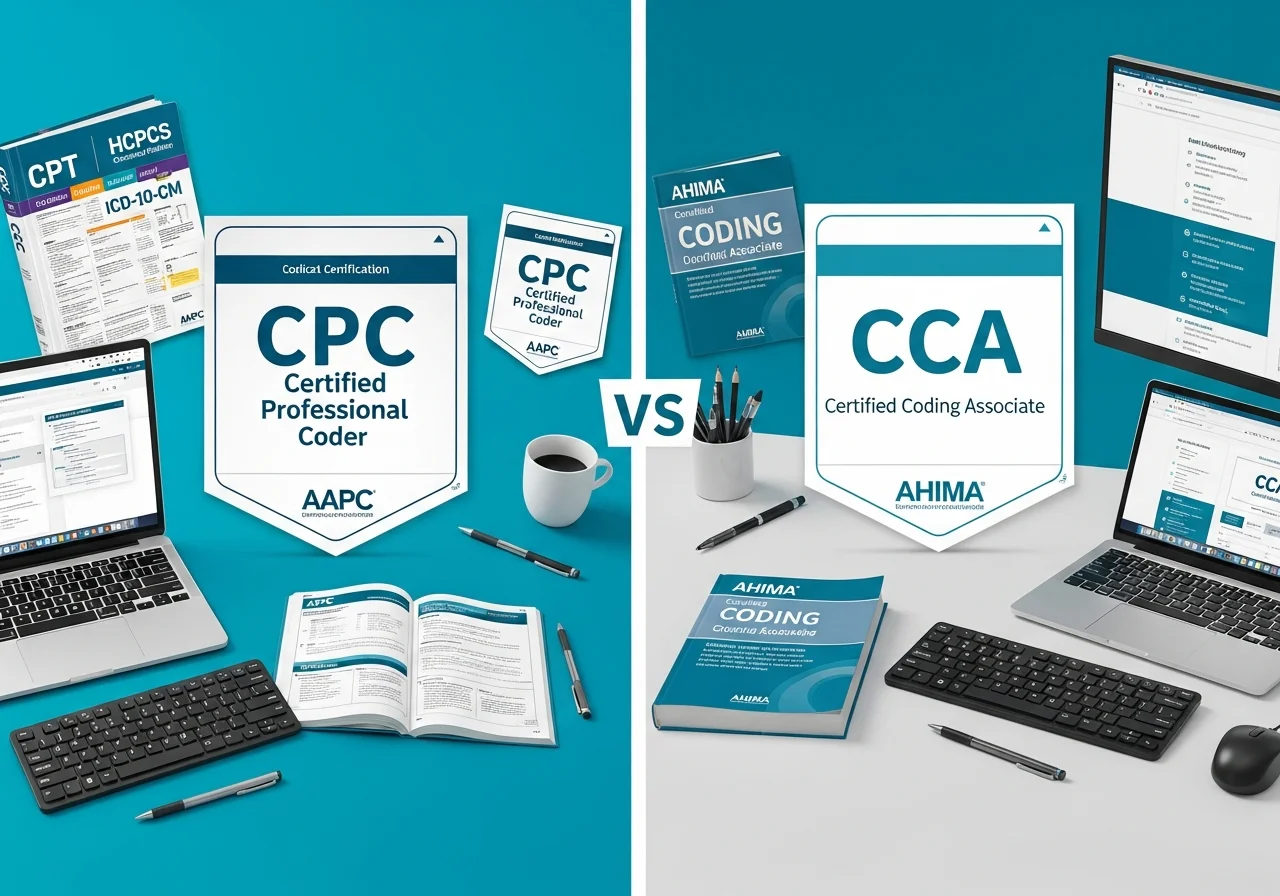
CPC vs CCA: Which Certification?
Comparing AAPC and AHIMA entry-level certifications: cost, difficulty, employer preference, and career impact.

Can AI Replace Medical Coders?
What automation means for medical coders: which tasks are changing and which skills remain essential.

Angela R.
Medical Billing & Coding Specialist | Consultant
Angela worked as a medical billing and coding specialist for multiple chiropractors and orthopedic surgeons. After years in the field, she started her own medical billing and coding consulting company, working with numerous clients throughout Southern California. She brings firsthand industry experience to every article on this site.