
You can become a medical biller and coder in 6 to 18 months. Complete a certificate or associate degree program, pass a certification exam (CPC, CCA, or CBCS), and apply for entry-level positions. The BLS reports 14,200 annual openings with 7% job growth through 2034. Median pay is $50,250 per year, and certified professionals average $66,979.
- 1.You don't need a four-year degree. Most employers require a certificate (4-15 months) or associate degree (~2 years) plus a professional certification.
- 2.The CPC from AAPC and the CCA from AHIMA are the two most recognized entry-level medical billing and coding certifications.
- 3.Total investment ranges from about $1,500 (community college certificate plus exam fee) to $20,000+ (associate degree at a private institution).
- 4.The BLS projects 7% job growth for medical records specialists (SOC 29-2072) from 2024 to 2034, with 14,200 annual openings.
- 5.Certified professionals earn significantly more. AAPC reports an average of $66,979 for certified coders vs. $55,721 for non-certified, a 20.7% premium.
$50,250/yr
Median Salary
7%
Job Growth
2024-2034
14,200
Annual Openings
4-15 months
Fastest Path
Certificate program
Your Path to Becoming a Medical Biller and Coder
Total Time: 6-24 monthsResearch the Field
Read job postings, review BLS data, and connect with working professionals to confirm this career fits your strengths.
Complete a Training Program
Finish a certificate (4-15 months, $1,000-$5,000) or associate degree (~2 years, $3,000-$20,000+) covering ICD-10-CM, CPT, HCPCS, and medical terminology.
Get Hands-On Practice
Complete a practicum or externship. If your program doesn't include one, use AAPC's Practicode tool for 500+ real-world coding cases.
Pass a Certification Exam
Earn the CPC ($425-$499), CCA ($199-$299), or CBCS (~$117). Certification is a practical requirement for employment.
Build Your Resume
Highlight your credential, training program, coding software proficiency, and any practicum experience.
Apply for Jobs
Search for medical coder, billing specialist, and claims processor roles on Indeed, LinkedIn, and AAPC's job board.
Step 1: Research the Field
If you're figuring out how to become a medical biller and coder, start by understanding what the work actually looks like. Spend a few weeks reading job postings on Indeed and LinkedIn. Check the BLS Occupational Outlook Handbook page for medical records specialists (SOC 29-2072) to see salary ranges, growth projections, and typical work conditions.
Talk to working professionals if you can. AAPC and AHIMA both have local chapters where members share their experiences. Reddit's r/MedicalCoding and AAPC's member forums give you unfiltered perspectives on day-to-day realities, including tight deadlines, repetitive work, and the constant need to stay current with annual code updates.
This step costs nothing but helps you confirm the work aligns with your strengths: attention to detail, comfort with medical terminology, and tolerance for desk-based computer work.
The process of submitting claims to insurance companies and following up on payments. Billers handle the revenue cycle from patient registration through final payment collection.
Key Points
- Insurance claim submission
- Accounts receivable
- Denial management
- HIPAA compliance
Common Jobs
- • Medical billing specialist
- • Claims processor
- • Revenue cycle analyst
Translating clinical documentation (diagnoses, procedures, services) into standardized alphanumeric codes using ICD-10-CM, CPT, and HCPCS Level II systems.
Key Points
- ICD-10-CM coding
- CPT/HCPCS coding
- Anatomy knowledge
- Medical terminology
Common Jobs
- • Medical coder
- • Coding associate
- • HIM technician
Step 2: Complete a Training Program
You have three main education paths for medical billing and coding programs, and all can lead to the same entry-level jobs.
Certificate programs (4-15 months): The fastest route. These focus exclusively on coding systems (ICD-10-CM, CPT, HCPCS), medical terminology, anatomy, and billing procedures. Tuition runs $1,000 to $5,000 at community colleges. Many are available entirely online. See our online programs guide for options.
Associate degree programs (~2 years): These include general education courses alongside the coding and billing curriculum. They cost $3,000 to $20,000+ depending on the institution, but result in a degree that helps with advancement into supervisory or health information management roles. Some employers, particularly hospitals, prefer candidates with an associate degree.
Bachelor's degree programs (4 years): A bachelor's in health information management (HIM) is less common for entry-level billing and coding classes, but it opens paths to management, compliance, and HIM director roles. These programs are often accredited by CAHIIM.
Source: AAPC 2025 Salary Survey
Step 3: Get Hands-On Practice
Classroom knowledge isn't enough on its own. Before sitting for a certification exam, you need practical experience with real or realistic medical records. Many training programs include a practicum or externship that places you in a hospital, physician office, or billing company for supervised coding practice.
If your program doesn't include a practicum, look for other ways to build practical skills. AAPC offers Practicode, an online tool with 500+ real-world medical cases for coding practice. AHIMA has similar resources for its members. Become comfortable navigating ICD-10-CM, CPT, and HCPCS coding manuals, their indices, tabular lists, and guidelines.
This hands-on experience does double duty: it prepares you for the certification exam (which tests applied coding, not memorization) and gives you something concrete to discuss in job interviews.
Step 4: Pass a Certification Exam
Medical billing and coding certification isn't legally required, but it's a practical requirement. Employers overwhelmingly prefer, and often require, candidates who hold a recognized credential. Here are your main entry-level options:
Recommended Specializations
CPC (Certified Professional Coder)
AAPCThe most widely held coding credential in the U.S. The exam has 100 questions (4 hours). Covers ICD-10-CM, CPT, HCPCS Level II, anatomy, compliance, and payment methodologies. You'll need AAPC membership ($222/yr, $157 for students). See our <a href="/certifications/cpc/">CPC certification guide</a>.
CCA (Certified Coding Associate)
AHIMAAn entry-level credential for coders with less experience. The exam has 105 questions (2 hours). A solid choice if you plan to pursue AHIMA's advanced credentials (CCS, RHIT, RHIA). See our <a href="/certifications/cca/">CCA certification guide</a>.
CBCS (Certified Billing and Coding Specialist)
NHACovers both billing and coding topics. The exam has 100 scored questions plus 20 pretest questions. Often bundled with NHA-approved training programs. See our <a href="/certifications/cbcs/">CBCS certification guide</a>.
CPB (Certified Professional Biller)
AAPCSpecifically for billing professionals. Covers the revenue cycle from patient registration through collections, including insurance follow-up, appeals, and compliance.
Source: AAPC 2025 Salary Survey
Step 5: Build Your Resume
With your training complete and certification earned, build a resume that highlights your credentials and practical experience. Include your certification name and credential ID, the training program you completed, software proficiency (EHR systems, practice management software, encoder tools), and any practicum or externship details.
If you're a career changer, translate transferable skills from your previous work. Experience with data entry, insurance claims processing, customer service, or healthcare administration all have direct relevance to billing and coding roles.
Resume Essentials Checklist
Certification and credential ID
List your CPC, CCA, CBCS, or CPB credential with the ID number. If you hold a CPC-A (Apprentice) designation, include it. Many employers hire CPC-A holders for entry-level roles.
Training program and coursework
Name the program, institution, and completion date. Mention key coursework: ICD-10-CM, CPT, HCPCS Level II, anatomy, medical terminology, and HIPAA compliance.
Software proficiency
List any EHR systems, practice management software, or encoder tools you've used. Common ones include Epic, Cerner, 3M, Optum, and EncoderPro.
Practicum or externship experience
Describe the setting (hospital, clinic, billing company), duration, and types of records you coded. Quantify when possible: number of charts reviewed, code sets used, accuracy rates.
Step 6: Apply for Jobs
Entry-level positions carry titles like medical coder, medical billing specialist, coding associate, claims processor, or health information technician. Search job boards (Indeed, LinkedIn, ZipRecruiter), healthcare system career pages, and AAPC's job board. For remote options, see our remote medical billing and coding jobs guide.
New CPC holders who haven't yet built professional experience receive the CPC-A (Apprentice) designation from AAPC. This is normal and expected. Many employers hire CPC-A holders for entry-level positions. The apprentice designation is removed after you complete the required experience hours.
The BLS reports 14,200 annual openings for medical records specialists, driven by both new job creation and replacement of workers who retire or leave the field. With 7% projected growth from 2024 to 2034 (faster than average for all occupations), demand for qualified billers and coders stays solid. For a detailed timeline breakdown, see our how long does it take guide.
Timeline and Cost Summary
| Path | Duration | Typical Cost | Best For | |
|---|---|---|---|---|
| Certificate Program | Certificate Program | 4-15 months | $1,000-$5,000 | Fastest entry to the workforce |
| Associate Degree | Associate Degree | ~2 years | $3,000-$20,000+ | Career advancement, hospital jobs |
| CPC Exam (AAPC) | CPC Exam (AAPC) | 1-3 months prep | $425-$499 | Most recognized credential |
| CCA Exam (AHIMA) | CCA Exam (AHIMA) | 1-2 months prep | $199-$299 | AHIMA career track |
| CBCS Exam (NHA) | CBCS Exam (NHA) | 1-2 months prep | ~$117 | Budget-friendly option |
Source: AAPC, AHIMA, NHA, community college data (2025)
Source: AAPC 2025 Salary Survey
Frequently Asked Questions
Related Guides
Latest Articles

Medical Billing and Coding Industry Trends 2026
AI-assisted coding, value-based care, and remote work are reshaping the medical coding profession.
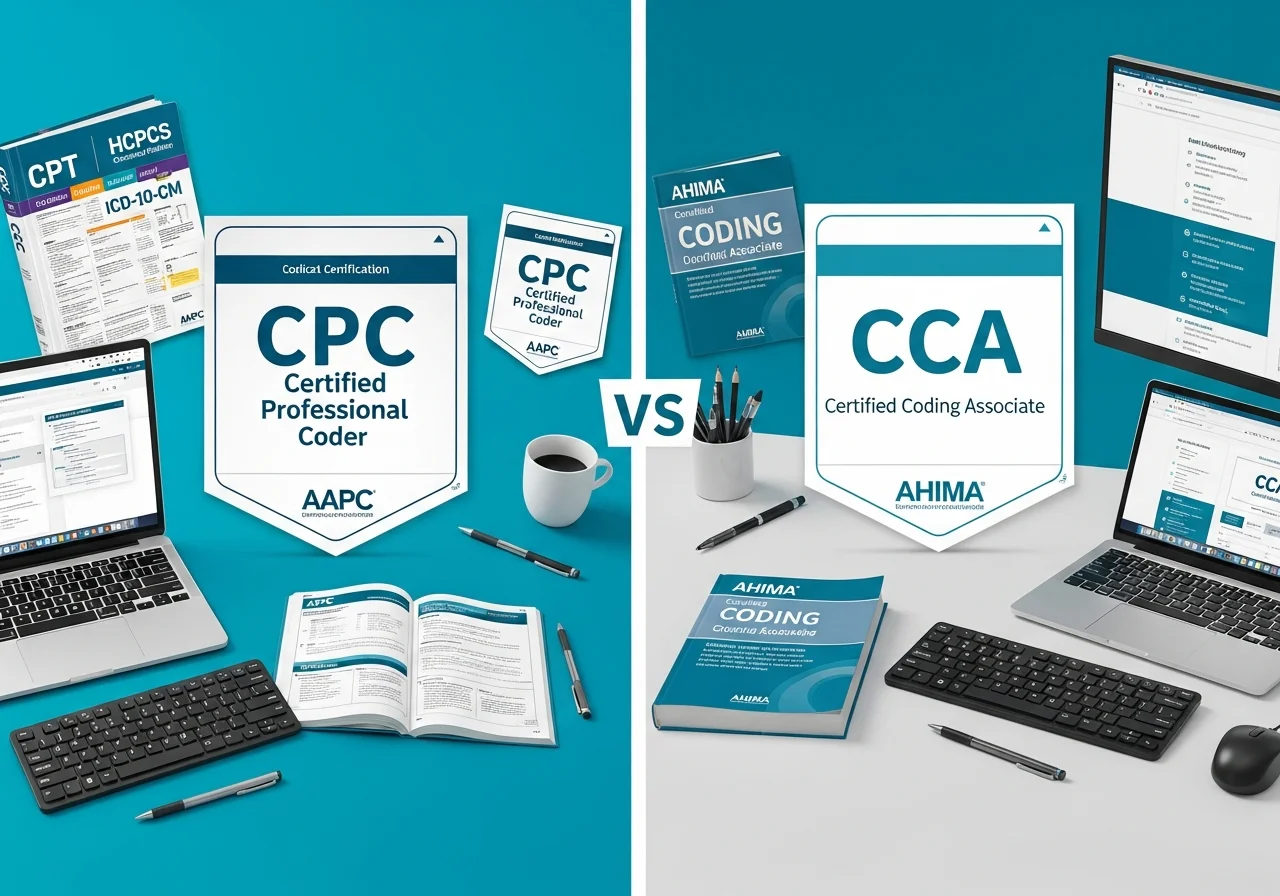
CPC vs CCA: Which Certification?
Comparing AAPC and AHIMA entry-level certifications: cost, difficulty, employer preference, and career impact.

Can AI Replace Medical Coders?
What automation means for medical coders: which tasks are changing and which skills remain essential.

Angela R.
Medical Billing & Coding Specialist | Consultant
Angela worked as a medical billing and coding specialist for multiple chiropractors and orthopedic surgeons. After years in the field, she started her own medical billing and coding consulting company, working with numerous clients throughout Southern California. She brings firsthand industry experience to every article on this site.