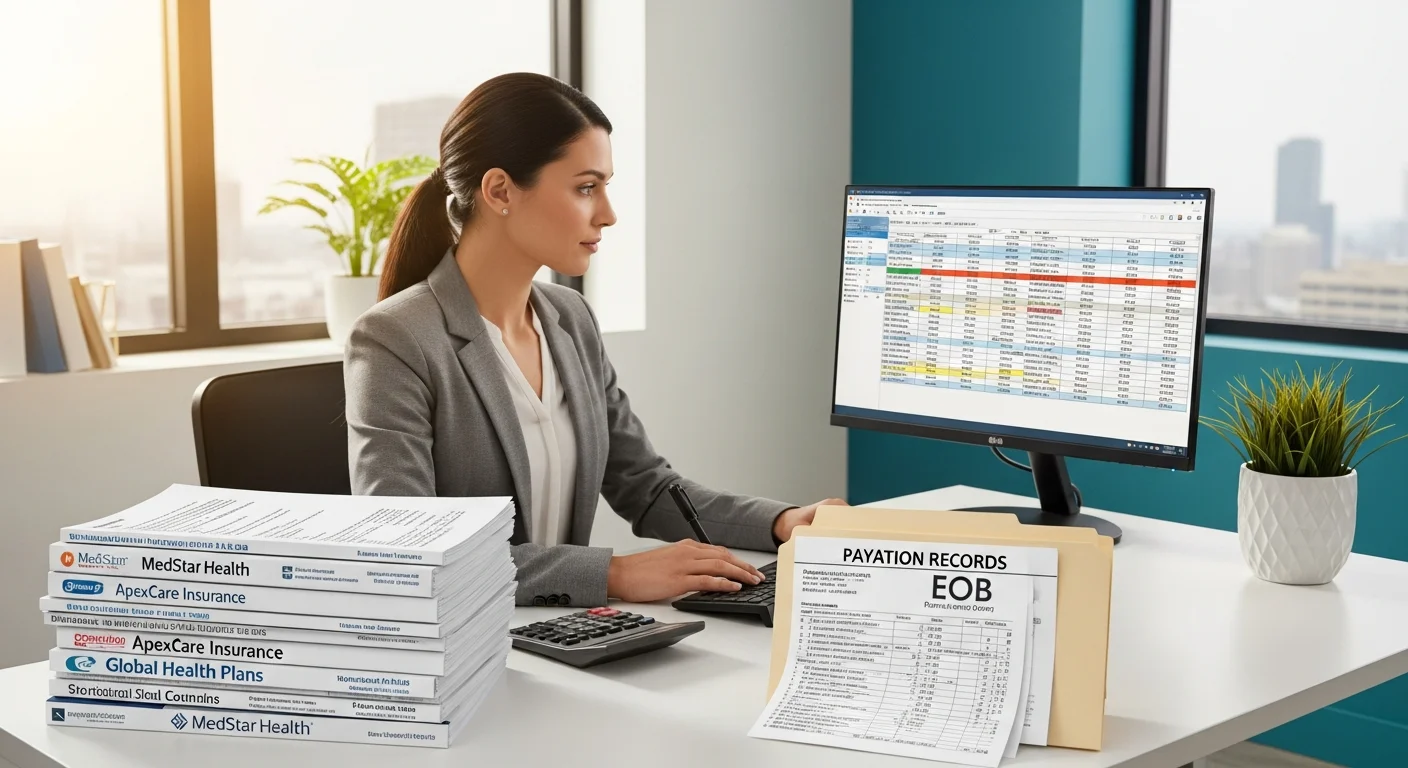
The CPB certification from AAPC is the only billing-specific credential from a major certifying body. It validates your ability to manage the full revenue cycle, from insurance verification through claims submission, payment posting, denial management, and collections. The exam costs $425 for one attempt or $499 for two attempts, plus required AAPC membership at $222 per year. CPB holders earn a median of $56,981, and professionals with both the CPC and CPB average $71,130 per year.
- 1.The CPB is AAPC's billing-specific credential, distinct from the CPC which focuses on coding.
- 2.The exam costs $425 for one attempt or $499 for two attempts, plus AAPC membership ($222/year or $157 for students).
- 3.Format: 200 multiple-choice questions, 5 hours and 40 minutes, open-codebook.
- 4.50 of the 200 questions are case analysis scenarios that simulate real-world billing situations.
- 5.A passing score is 70% (140 out of 200 correct answers).
- 6.Renewal requires 36 CEUs every 2 years plus active AAPC membership.
$425-$499
Exam Fee
1 or 2 attempts
200
Total Questions
Including 50 case analysis
5h 40m
Time Limit
Open-codebook format
$56,981
CPB Median Salary
AAPC 2025 Salary Survey
70%
Passing Score
140 out of 200 correct
36 CEUs
Renewal
Every 2 years + AAPC membership
What Is the CPB Certification?
The CPB (Certified Professional Biller) is a professional credential from the American Academy of Professional Coders (AAPC). It's the only billing-specific certification AAPC offers and validates your ability to manage the full revenue cycle, from patient registration and insurance verification through claims submission, payment posting, denial management, and collections.
While the CPC focuses on translating medical documentation into codes, the CPB focuses on what happens after coding: getting claims paid correctly and on time. That includes understanding payer contracts, processing claims through clearinghouses, managing accounts receivable, appealing denied claims, and staying compliant with federal and state billing regulations.
Most CPB candidates either already hold the CPC and want to formalize their billing expertise, or they're dedicated billing specialists working in physician practices, billing companies, or hospital business offices.
Source: AAPC 2025 Salary Survey
CPB Exam Format and Structure
The CPB exam has 200 multiple-choice questions with a 5-hour, 40-minute time limit. You'll need 70% to pass, which means 140 correct answers out of 200 (AAPC, MedicalBillingAndCoding.org).
The exam is open-codebook. You can bring your current-year and previous-year coding manuals: ICD-10-CM, CPT Professional Edition, and HCPCS Level II. Codebooks can be tabbed and annotated, but loose papers and notes aren't allowed.
A big portion of the exam involves case analysis questions. Fifty of the 200 questions present case-based scenarios simulating real-world billing situations. You'll analyze documents, apply insurance rules, and make decisions about claim processing, denial resolution, and payment posting.
You can take the exam at a Pearson VUE testing center or online through AAPC's remote proctoring system. The online option requires a webcam, reliable internet, and a private workspace.
CPB Certification Cost Breakdown
| Fee Type | Amount | Notes |
|---|---|---|
| Exam Fee (1 Attempt) | $425 | Single attempt at exam |
| Exam Fee (2 Attempts) | $499 | $74 savings vs. paying for a retake separately |
| AAPC Membership (Required) | $222/year | Professional membership |
| Student Membership | $157/year | For currently enrolled students |
| Minimum Total Cost | $582-$647 | Exam + first year of membership |
| Renewal (36 CEUs) | Included with membership | CEUs must be submitted every 2 years |
Source: AAPC, 2025
Eligibility Requirements
AAPC doesn't impose strict educational prerequisites for the CPB exam. To be eligible, you'll need the following (AAPC):
Education: There's no formal education requirement, though AAPC recommends at least a high school diploma or equivalent. An associate degree is suggested but not required.
Experience: AAPC recommends at least two years of professional experience in medical billing or a related field. That includes claims processing, reimbursement management, coding, or billing documentation. Experience from employment, externships, or apprenticeships all counts.
Membership: Active AAPC membership is required when you take the exam. That's $222/year for professionals or $157/year for students (AAPC).
If you pass without the recommended experience, you'll still receive your credential. Unlike the CPC, there's no formal "apprentice" designation for the CPB.
Commercial plans, managed care (HMO, PPO, POS), Medicare Part A/B/C/D, Medicaid, Tricare, workers' compensation, and coordination of benefits. This is the largest single domain.
Document-based scenarios requiring you to review EOBs, remittance advice, and claims data to identify correct billing actions, modifier application, and payment resolution.
Payment posting, adjustment processing, accounts receivable management, patient billing, collections protocols, and financial counseling.
Claims creation and formatting, electronic data interchange (EDI), clearinghouse operations, claim scrubbing, and submission workflows.
Medicare billing rules, Medicaid requirements, appeals processes, timely filing deadlines, and payer-specific requirements.
Basic CPT, ICD-10-CM, and HCPCS concepts as they apply to billing accuracy. This isn't a deep coding test, just how coding affects billing outcomes.
HIPAA privacy and security regulations, fraud and abuse prevention, OIG compliance guidance, and the False Claims Act.
What the CPB Exam Covers
The CPB tests applied billing knowledge across seven content domains. The two largest sections are insurance types (44 questions) and case analysis (50 questions), which together account for nearly half the exam. Reimbursement/collections and billing each have 28 questions, billing regulations has 25, coding has 15, and HIPAA/compliance has 10.
The case analysis section is where many candidates struggle. You'll review source documents like EOBs, remittance advice, and claim forms, then identify the correct billing action. Practicing with real-world documents is the best preparation for these questions.
Study Tips and CPB Exam Preparation
Master insurance types and payer rules first
Insurance types (44 questions) and case analysis (50 questions) are the two largest domains. Understand the differences between Medicare, Medicaid, commercial plans, and workers' compensation, including their specific billing rules.
Practice case analysis with real documents
Fifty questions present document-based cases. Practice reading EOBs (Explanation of Benefits), remittance advice, and claims data to identify errors, denials, and correct actions.
Study the revenue cycle end to end
Understand every step from patient registration through final payment: charge capture, claim submission, payment posting, denial management, and collections.
Learn denial management thoroughly
Know the most common denial reasons (timely filing, missing authorization, incorrect patient info, coding errors) and the proper appeal processes for each payer type.
Use AAPC's official study guide and practice exams
AAPC offers preparation materials aligned with the exam content. Timed practice exams help build the pacing discipline you'll need for 200 questions in under 6 hours.
Plan for 3 to 5 months of study
Most CPB candidates with billing experience spend 3 to 5 months preparing. If you don't have much hands-on billing experience, budget additional time.
Source: BLS OEWS, May 2024
Maintaining Your CPB Certification
Your CPB must be renewed every two years. That means 36 continuing education units (CEUs) submitted within each cycle, plus active AAPC membership (AAPC).
Of the 36 CEUs, at least 24 (two-thirds) must come from core billing and coding topics. The remaining 12 can come from broader healthcare topics like practice management, healthcare technology, and regulatory updates.
CEUs come from AAPC workshops, local chapter meetings, approved online courses, webinars, and conferences. If you hold both the CPC and CPB, the same 36 CEUs satisfy both credentials. You don't need 72 total.
AAPC charges $50 for CEU deadline extensions. Excess CEUs from one cycle don't carry over. If you don't submit CEUs by your renewal date, your credential becomes inactive until you fulfill the requirement.
Source: AAPC 2025 Salary Survey
Career Impact and Salary Data
The CPB positions you for specialized billing roles that go beyond general coding. CPB holders work as billing managers, revenue cycle analysts, accounts receivable specialists, claims processing supervisors, and billing compliance officers.
According to the Bureau of Labor Statistics, medical records specialists (SOC 29-2072) earn a median annual salary of $50,250 as of May 2024 (BLS). The AAPC 2025 Salary Survey reports CPB holders earn a median of $56,981, and professionals holding both the CPC and CPB average $71,130 per year.
The CPB is especially relevant as healthcare billing grows more complex. Increasing payer requirements, prior authorization regulations, and the shift toward value-based reimbursement create strong demand for professionals who understand the full revenue cycle.
CPB vs. CBCS: Billing Credentials Compared
| Factor | CPB (AAPC) | CBCS (NHA) |
|---|---|---|
| Exam Fee | $425-$499 | ~$117 |
| Membership Required? | Yes ($222/yr) | No |
| Exam Format | Open-codebook | Closed-book |
| Questions | 200 (5h 40m) | 120 (100 scored) |
| Scope | Billing and revenue cycle | Billing + Coding combined |
| Best For | Experienced billing specialists, revenue cycle managers | Entry-level billing and coding graduates |
| Case Analysis | 50 document-based scenarios | None |
| Passing Score | 70% (140/200) | 390/500 scaled |
Source: AAPC, NHA (2025)
Frequently Asked Questions
Related Certification Guides
Latest Articles

Medical Billing and Coding Industry Trends 2026
AI-assisted coding, value-based care, and remote work are reshaping the medical coding profession.
CPC vs CCA: Which Certification?
Comparing AAPC and AHIMA entry-level certifications: cost, difficulty, employer preference, and career impact.

Can AI Replace Medical Coders?
What automation means for medical coders: which tasks are changing and which skills remain essential.

Angela R.
Medical Billing & Coding Specialist | Consultant
Angela worked as a medical billing and coding specialist for multiple chiropractors and orthopedic surgeons. After years in the field, she started her own medical billing and coding consulting company, working with numerous clients throughout Southern California. She brings firsthand industry experience to every article on this site.