Choosing the right medical billing and coding certification depends on your budget, work setting, and career goals. Five credentials dominate the field: CPC and CPB from AAPC, CCA and CCS from AHIMA, and CBCS from NHA. Certified professionals earn an average of $66,979 per year, roughly 20.7% more than their uncertified peers at $55,721. Stacking multiple credentials pushes that average to $81,227.
- 1.Five medical billing and coding certifications dominate the field: CPC (AAPC), CCA (AHIMA), CBCS (NHA), CCS (AHIMA), and CPB (AAPC).
- 2.Exam costs range from ~$117 (CBCS) to $647 (CPC or CPB with required AAPC membership).
- 3.The CPC is the most requested credential in outpatient settings. The CCS is the gold standard for hospital inpatient coding.
- 4.Certified professionals average $66,979/year vs. $55,721 for non-certified workers, a 20.7% premium (AAPC 2025 Salary Survey).
- 5.Holding three or more certifications correlates with an average salary of $81,227 (AAPC 2025 Salary Survey).
- 6.None of the five certifications require a college degree. CCA and CBCS require only a high school diploma.
CPC (AAPC)
Most Recognized
Outpatient coding standard
~$117
Most Affordable
CBCS exam (NHA)
+20.7%
Certification Premium
$66,979 vs. $55,721 avg.
$81,227
3+ Credentials Avg.
AAPC 2025 Survey
Medical Billing and Coding Certifications at a Glance
| Feature | CPC (AAPC) | CCA (AHIMA) | CBCS (NHA) | CCS (AHIMA) | CPB (AAPC) |
|---|---|---|---|---|---|
| Issuing Body | AAPC | AHIMA | NHA | AHIMA | AAPC |
| Credential Level | Entry to mid-level | Entry-level | Entry-level | Advanced | Mid-level |
| Primary Focus | Outpatient physician coding | Inpatient & outpatient coding | Billing and coding | Hospital inpatient coding | Billing & revenue cycle |
| Exam Questions | 100 | 105 (90 scored) | 120 (100 scored) | 107 (97 scored) | 200 |
| Time Limit | 4 hours | 2 hours | Not published | 4 hours | 5 hrs 40 min |
| Open/Closed Book | Open codebook | Open codebook | Closed book | Open codebook | Open codebook |
| Passing Score | 70% (70/100) | 300 (scaled) | 390/500 (scaled) | 300 (scaled) | 70% (140/200) |
| Exam Cost | $425 (1 attempt) | $199 members / $299 non-members | ~$117 | $299 members / $399 non-members | $425 (1 attempt) |
| Membership Required | Yes ($222/yr) | No | No | No | Yes ($222/yr) |
| Experience Required | No (CPC-A if none) | No (recommended) | Training or 1-2 yrs experience | Yes (1-2 yrs) | Recommended (2 yrs) |
| CEUs for Renewal | 36 per 2 years | 20 per 2 years | 10 CE credits per 2 years | 20 per 2 years | 36 per 2 years |
| Best For | Physician office coders | New coders seeking broad base | Training program graduates | Hospital coders | Billing specialists |
Source: AAPC, AHIMA, NHA. Data current as of February 2026.
AAPC's flagship coding credential. It focuses on outpatient physician-office coding using CPT, ICD-10-CM, and HCPCS Level II. The CPC is recognized across virtually all outpatient settings. Candidates who pass without documented experience receive the CPC-A (Apprentice) designation. Median salary: $58,895/year (AAPC 2025).
Key Points
- CPT code assignment
- ICD-10-CM diagnosis coding
- HCPCS Level II
- E/M level selection
- Surgical coding
Common Jobs
- • Outpatient medical coder
- • Physician office coder
- • Coding specialist
- • Remote medical coder
AHIMA's entry-level coding credential covering both inpatient and outpatient coding, including ICD-10-PCS for hospital procedures. It's less expensive than the CPC and provides broader foundational knowledge. The CCA serves as a stepping stone to AHIMA's advanced CCS certification.
Key Points
- ICD-10-CM diagnosis coding
- ICD-10-PCS procedure coding
- CPT/HCPCS coding
- Health record analysis
- Medical terminology
Common Jobs
- • Entry-level hospital coder
- • HIM department coder
- • Outpatient coder
- • Coding trainee
NHA's combined billing-and-coding credential and the most affordable option at ~$117. It's a closed-book exam (no code books allowed) that tests both billing and coding knowledge. The CBCS is NCCA-accredited and frequently bundled with training programs.
Key Points
- Claims submission
- Insurance verification
- ICD-10 and CPT basics
- Revenue cycle fundamentals
- Payment posting
Common Jobs
- • Billing and coding specialist
- • Medical office billing clerk
- • Claims processor
- • Patient account representative
AHIMA's advanced hospital coding credential. The CCS exam includes medical scenarios (case studies) and requires prior experience or a coding credential. It's the strongest credential for inpatient coding, DRG assignment, and hospital revenue integrity roles.
Key Points
- Inpatient DRG assignment
- Complex case coding
- ICD-10-PCS mastery
- Clinical documentation analysis
- Compliance auditing
Common Jobs
- • Hospital inpatient coder
- • Coding auditor
- • CDI specialist
- • Revenue integrity analyst
AAPC's billing-specific credential. The CPB validates expertise in revenue cycle management, claims processing, denial management, and payer reimbursement. It pairs well with the CPC for professionals who handle both coding and billing. Median salary: $56,981/year (AAPC 2025).
Key Points
- Claims management
- Denial appeals
- Payer contract interpretation
- Revenue cycle management
- Accounts receivable
Common Jobs
- • Medical billing specialist
- • Revenue cycle analyst
- • Denial management specialist
- • Billing supervisor
Source: AAPC 2025 Salary Survey
Which Medical Billing and Coding Certification Should You Choose?
The right certification depends on your career goals, budget, and current experience level. Here are the clearest paths:
You're new and want the most affordable option: Start with the CBCS (~$117) or the CCA ($199-$299). Both work as solid entry points. The CBCS is cheaper and covers billing, while the CCA provides broader coding knowledge across inpatient and outpatient settings.
You want to work in a physician office or outpatient clinic: The CPC is the most recognized credential for these settings. It costs more ($425 plus $222/year membership) but carries the most weight with outpatient employers.
You want to work in a hospital: Start with the CCA and advance to the CCS after gaining one year of coding experience. The CCS is the gold standard for hospital coding positions and DRG-based reimbursement work.
You work primarily in billing, not coding: The CPB is designed for billing professionals. It validates revenue cycle management skills that coding certifications don't cover in depth.
You want maximum versatility: Earn the CPC and CPB together for full coding-and-billing coverage in outpatient settings, or the CCA plus CCS for the strongest hospital combination.
You just graduated from a training program: Check whether your program includes a certification exam. Many NHA-approved programs bundle the CBCS exam in tuition. If not, choose based on your target work setting.
Total Cost Breakdown: Exam + First Year
CBCS (NHA) - ~$117 total
Exam fee only. No membership required. Often bundled free with NHA-approved training programs. Renewal: 10 CE credits every 2 years.
CCA (AHIMA Member) - $199 total
Exam fee with AHIMA membership discount. Non-members pay $299. AHIMA membership is optional but reduces the exam fee by $100. Renewal: 20 CEUs every 2 years.
CCS (AHIMA Member) - $299 total
Exam fee with membership discount. Non-members pay $399. Requires at least 1-2 years of coding experience or a prior credential. Renewal: 20 CEUs every 2 years.
CPC (AAPC) - $647 first year
$425 exam fee (1 attempt) plus $222/year AAPC membership (required). Two-attempt option: $499 + $222 = $721. Renewal: 36 CEUs every 2 years plus annual membership.
CPB (AAPC) - $647 first year
$425 exam fee (1 attempt) plus $222/year AAPC membership. If you already hold the CPC, you won't pay a second membership fee. The same 36 CEUs can cover both credentials.
Source: AAPC 2025 Salary Survey
Salary by Medical Billing and Coding Certification
Your certification directly affects what you'll earn. According to the AAPC 2025 Salary Survey, here's how credentials stack up:
Non-certified medical billing and coding professionals average $55,721/year. Those with one certification jump to an average of $62,689. Two certifications push the average to $71,130, and three or more credentials reach $81,227.
Among specific credentials, the CPC carries a median salary of $58,895, while the CPB comes in at $56,981. The CCS typically commands the highest individual-credential salaries because it qualifies holders for advanced hospital coding, auditing, and CDI positions.
The BLS reports a broader median of $50,250/year for all medical records specialists (SOC 29-2072), which includes both certified and uncertified workers. The gap between BLS and AAPC figures highlights the measurable financial benefit of getting certified.
Stacking Multiple Medical Billing and Coding Certifications
| Combination | Best For | Why It Works |
|---|---|---|
| CPC + CPB | Full coding-and-billing coverage in outpatient settings | AAPC offers combined prep courses. The same 36 CEUs cover both credentials, and you only pay one membership fee. |
| CCA + CCS | The AHIMA progression for hospital coding careers | CCA plus one year of experience meets CCS eligibility. Both require 20 CEUs per cycle from the same organization. |
| CPC + CCS | Professionals working across outpatient and inpatient settings | Combines AAPC's outpatient strength with AHIMA's hospital coding expertise. Maximizes your employer options. |
| CBCS + CPC | Budget-conscious career starters building toward top credential | Start affordably with the CBCS (~$117), gain experience, then add the CPC for stronger employer recognition and higher pay. |
Source: AAPC and AHIMA certification program details
Source: AAPC 2025 Salary Survey
What Employers Prefer by Work Setting
Employer preferences vary by setting, and knowing which certification each type of employer values can save you time and money.
Physician offices and outpatient clinics: The CPC is the most frequently requested credential. Some postings accept the CCA or CBCS for entry-level positions.
Hospitals and health systems: The CCS is preferred for inpatient coding. The CCA is accepted for entry-level hospital coding. Some hospitals also accept the CPC for outpatient facility coding.
Billing companies and revenue cycle firms: The CPB or CPC for billing roles, CBCS for entry-level positions. Many billing companies value practical experience alongside any recognized credential.
Remote coding positions: CPC or CCS are most commonly required, depending on outpatient vs. inpatient records. Remote employers typically require at least 2 years of experience plus a recognized credential.
Training programs and schools: The CBCS is common because many programs are NHA-approved and bundle the exam. Graduates often earn the CPC or CCA later for career advancement.
Regardless of which credential you start with, gaining practical experience matters most for career growth. Employers value certified professionals who can demonstrate accurate, efficient work on real medical records. See our how to become a medical coder guide for a complete roadmap.
Source: BLS Occupational Outlook Handbook, 2024-2034
Frequently Asked Questions
Explore Individual Certification Guides
Latest Articles

Medical Billing and Coding Industry Trends 2026
AI-assisted coding, value-based care, and remote work are reshaping the medical coding profession.
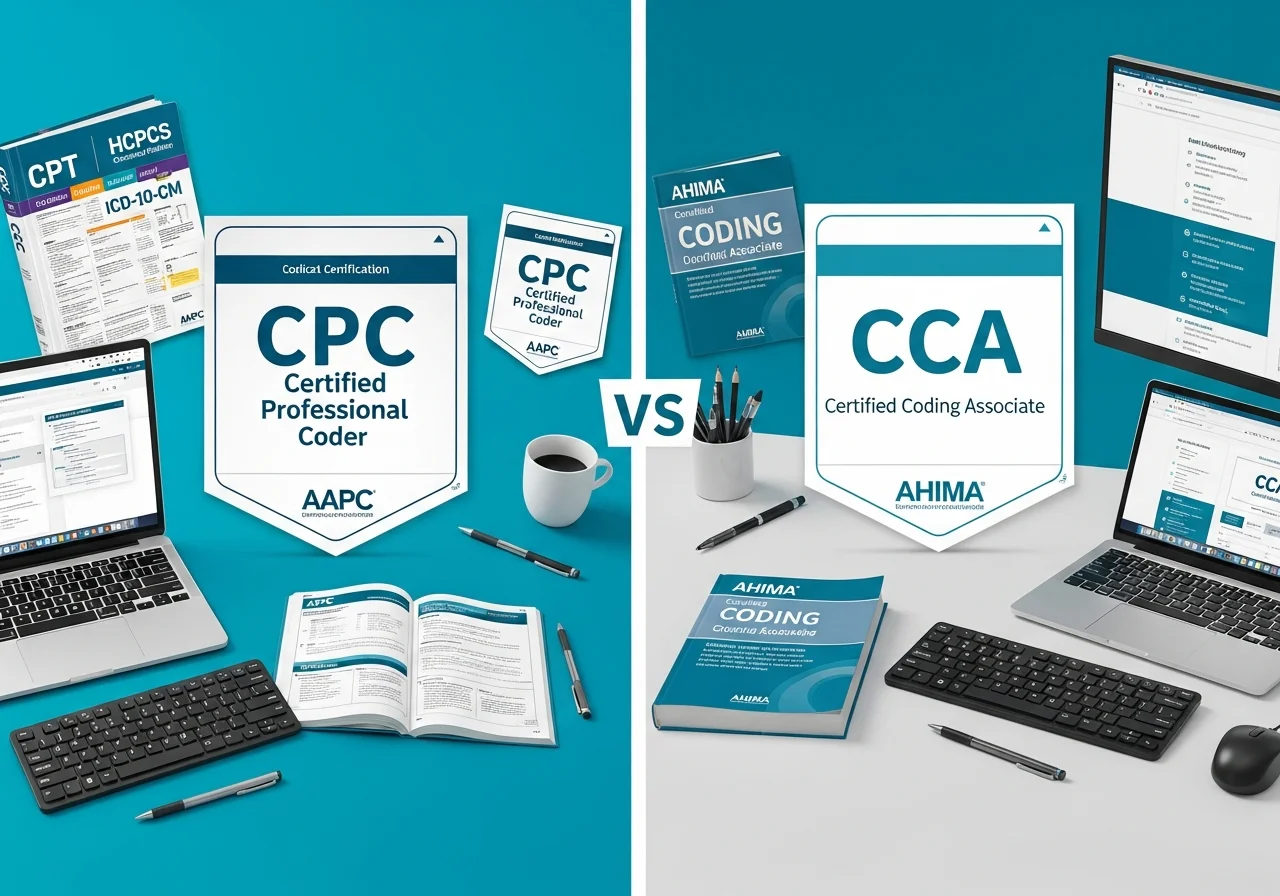
CPC vs CCA: Which Certification?
Comparing AAPC and AHIMA entry-level certifications: cost, difficulty, employer preference, and career impact.

Can AI Replace Medical Coders?
What automation means for medical coders: which tasks are changing and which skills remain essential.

Angela R.
Medical Billing & Coding Specialist | Consultant
Angela worked as a medical billing and coding specialist for multiple chiropractors and orthopedic surgeons. After years in the field, she started her own medical billing and coding consulting company, working with numerous clients throughout Southern California. She brings firsthand industry experience to every article on this site.