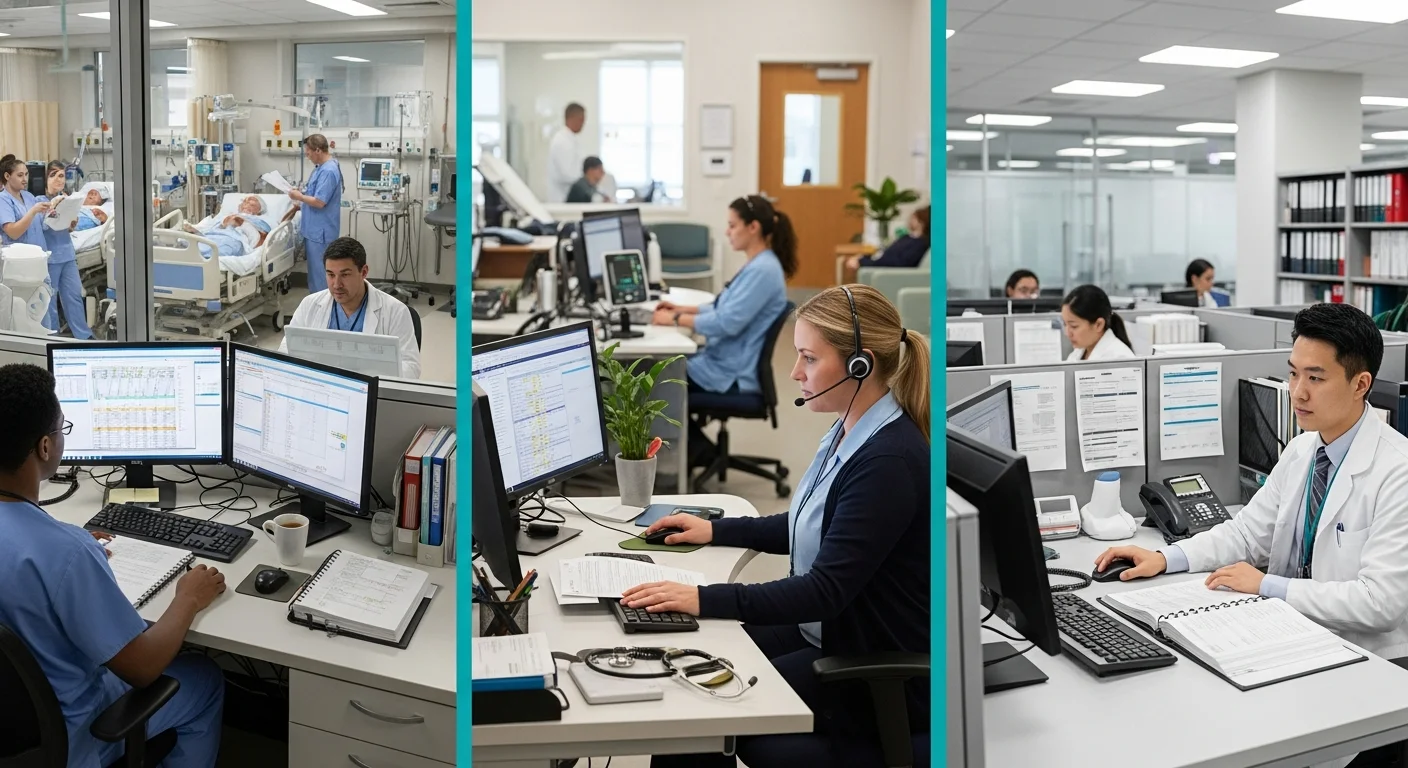
Medical billing and coding specializations consistently pay more than generalist roles. CCS-certified inpatient coders earn $70,000-$85,000, HCC risk adjustment coders average ~$84,640, and coding auditors reach $70,000-$95,000. The BLS median for all medical records specialists is $50,250, but professionals with three or more AAPC certifications average $81,227, which is 62% above that baseline.
- 1.Specialized coders consistently earn more than generalists. CCS-certified inpatient coders earn $70,000-$85,000 per year, compared to the $50,250 BLS median for all medical records specialists.
- 2.HCC risk adjustment coding is one of the fastest-growing specialties, driven by the shift to value-based care and Medicare Advantage plan expansion.
- 3.AAPC offers over a dozen specialty credentials beyond the CPC, including CRC (risk adjustment), CEMC (evaluation and management), COSC (surgical), and several organ-system-specific certifications.
- 4.Coding auditors and compliance specialists command some of the highest salaries in the field, typically $70,000-$95,000 per year.
- 5.Professionals holding three or more AAPC certifications average $81,227 per year, 62% above the BLS median, according to the 2025 AAPC salary survey.
$50,250
BLS Generalist Median
$81,227
3+ Certs Average
~$84,640
HCC Coder Average
62%
Above Median (3+ Certs)
Why Specialize in Medical Billing and Coding?
Generalist medical coders assign codes across a broad range of encounter types. Specialist coders focus on a specific setting, procedure type, or clinical area, and that focus commands higher pay. The salary gap between generalists and specialists reflects the deeper knowledge required, the smaller talent pool, and the financial stakes involved.
According to AAPC's 2025 salary survey, certified professionals earn approximately 20.7% more than uncertified peers. Adding specialty credentials on top of a base CPC or CCS certification widens the gap further. Professionals with three or more AAPC certifications average $81,227 per year, which is 62% above the $50,250 BLS median for medical records specialists.
Specialization also offers more job security. Healthcare organizations need specialists they can't easily replace with entry-level hires. An HCC coder, surgical coding expert, or compliance auditor has skills that take years to develop, making these professionals less vulnerable to layoffs or automation.
Source: AAPC 2025 Salary Survey
Inpatient Facility Coding
Inpatient coders work with hospital admissions, patients who are formally admitted for at least one overnight stay. This is some of the most complex coding work in the field because it involves ICD-10-PCS (Procedure Coding System) for surgical and procedural reporting, in addition to ICD-10-CM for diagnoses.
Inpatient coders assign DRGs (diagnosis-related groups) that directly determine how much Medicare and other payers reimburse the hospital. A single coding decision can shift a DRG assignment and change the reimbursement by thousands of dollars. This high-stakes environment is why inpatient coding commands premium pay.
The CCS (Certified Coding Specialist) from AHIMA is the standard credential for inpatient facility coding. CCS holders earn between $70,000 and $85,000 per year. AAPC's CIC (Certified Inpatient Coder) is an alternative that has gained traction, with holders earning $68,000-$80,000. Most inpatient positions require at least 2-3 years of coding experience before specializing.
Source: AAPC salary data; industry benchmarks
Outpatient and Physician Coding
Outpatient coding covers encounters where the patient isn't formally admitted to a hospital: physician office visits, ambulatory surgery center (ASC) procedures, emergency department visits, and diagnostic testing. This is the most common coding specialty and where most coders start their careers.
Outpatient coders work primarily with CPT codes and ICD-10-CM diagnosis codes. Evaluation and management (E/M) coding is a core skill, as E/M codes represent a large volume of outpatient encounters. The CPC from AAPC is the primary credential, and the COC (Certified Outpatient Coder) provides additional specialty recognition for hospital outpatient departments or ASCs.
Generalist outpatient coders typically earn $45,000-$60,000, while those with specialty knowledge (E/M auditing, ASC coding) can earn $60,000-$75,000. For details on the full salary range, see our salary guide.
Source: ZipRecruiter, 2024
HCC Risk Adjustment Coding
Hierarchical Condition Category (HCC) coding is one of the fastest-growing medical billing and coding specializations. HCC coders review medical records to identify and validate chronic conditions that affect risk-adjusted payments under Medicare Advantage and certain commercial insurance plans.
Unlike traditional coding, which focuses on the encounter being billed, risk adjustment coding captures a patient's overall disease burden to calculate expected healthcare costs. Each validated HCC code increases the plan's per-member reimbursement from CMS. This makes HCC coding a direct revenue driver for Medicare Advantage organizations.
The CRC (Certified Risk Adjustment Coder) from AAPC is the standard credential. Demand for CRC holders has increased significantly with the growth of Medicare Advantage, which now has over 33 million beneficiaries enrolled as of 2024. Many HCC positions are remote and may be full-time, part-time, or seasonal (risk adjustment coding work often peaks during annual chart review cycles).
Top 3 Medical Billing and Coding Specializations at a Glance
| Specialty | Key Credential | Average Salary | Remote Friendly? |
|---|---|---|---|
| Inpatient Facility | CCS (AHIMA) | $70,000-$85,000 | Moderate-High |
| HCC Risk Adjustment | CRC (AAPC) | ~$84,640 | Very High |
| Coding Auditing | CPMA (AAPC) | $70,000-$95,000 | Very High |
Surgical Coding
Surgical coding is a premium specialty that requires deep knowledge of CPT's surgical sections (10000-69999), operative report interpretation, and modifier application. Surgical coders work with complex procedures across multiple body systems, and accuracy directly affects reimbursement.
Key skills include interpreting operative notes (which vary widely in style and detail), understanding anatomy at a level sufficient to distinguish between related procedures, and applying bundling rules. National Correct Coding Initiative (NCCI) edits determine which procedures can and can't be billed together. Experienced surgical coders typically earn $60,000-$80,000, with those specializing in cardiothoracic or neurosurgical coding at the higher end.
Covers diagnostic cardiology (EKGs, echocardiograms, stress tests), interventional procedures (cardiac catheterization, stent placement), and electrophysiology studies. AAPC offers the CCVTC credential.
Involves musculoskeletal procedures including joint replacements, arthroscopic surgery, fracture repairs, and spine procedures. AAPC's COPC credential validates this expertise.
Covers chemotherapy, radiation therapy, surgical oncology, and complex staging protocols. Requires understanding of treatment protocols and drug coding through HCPCS Level II.
Focuses on diagnostic imaging (X-ray, CT, MRI, ultrasound) and interventional radiology. Often involves component billing (professional vs. technical) that requires careful modifier use.
A niche specialty with its own time-based calculation methodology using base units, time units, and physical status modifiers. The small number of qualified anesthesia coders keeps pay competitive.
ED coders handle high-volume, variable-complexity encounters ranging from minor injuries to critical care. Speed and breadth of knowledge are both essential.
Coding Auditing and Compliance
Coding auditors review coded records after the fact to assess accuracy, identify patterns of over- or undercoding, and ensure compliance with federal and state regulations. This is a senior-level role that typically requires 5+ years of production coding experience.
Auditors conduct both internal audits (reviewing the organization's own coding) and may be involved in external audits (preparing for or responding to payer audits, RAC audits, or OIG investigations). Their findings directly influence education, process improvements, and risk mitigation.
The CPMA (Certified Professional Medical Auditor) from AAPC is the primary credential. Compliance-focused roles may also benefit from the CPCO (Certified Professional Compliance Officer) credential. Auditors earn $70,000-$95,000 per year, with directors of compliance and coding integrity earning over $100,000. These roles are often remote-friendly because audit work can be performed from any location with system access.
Source: AAPC salary data; ZipRecruiter 2024
Medical Billing and Coding Specialization Salary Comparison
| Specialization | Salary Range | Key Credential | Remote Availability |
|---|---|---|---|
| Entry-Level/Generalist Outpatient | $35,000-$50,000 | CPC (AAPC) | Moderate |
| Mid-Level Outpatient (2-5 yrs) | $50,000-$65,000 | CPC + specialty | High |
| Inpatient Facility | $70,000-$85,000 | CCS (AHIMA) or CIC | Moderate-High |
| Surgical Coding | $60,000-$80,000 | COSC (AAPC) | High |
| HCC Risk Adjustment | ~$84,640 avg, $100K+ top | CRC (AAPC) | Very High |
| Coding Auditor | $70,000-$95,000 | CPMA (AAPC) | Very High |
| Compliance Officer | $75,000-$100,000+ | CPCO (AAPC) | High |
How to Start Specializing
Most coders work 2-3 years in general outpatient coding before specializing. You don't need to go back to school. Specialty credentials from AAPC and AHIMA are earned through certification exams, not additional degree programs. Self-study, online courses (AAPC and AHIMA both offer specialty exam prep), and on-the-job experience in the specialty area are the standard preparation methods.
The specialty you choose should match your interests, your employer's needs, and your local job market. If you enjoy complex analytical work, inpatient facility coding (CCS or CIC) is a natural progression. If you want remote flexibility and strong demand, HCC risk adjustment (CRC) is hard to beat. If you prefer quality assurance, coding auditing (CPMA) offers high pay and a different workflow than production coding.
For a full breakdown of each credential's requirements, exam format, and cost, see our certifications comparison page.
Source: BLS Occupational Outlook Handbook
Frequently Asked Questions
Latest Articles

Medical Billing and Coding Industry Trends 2026
AI-assisted coding, value-based care, and remote work are reshaping the medical coding profession.
CPC vs CCA: Which Certification?
Comparing AAPC and AHIMA entry-level certifications: cost, difficulty, employer preference, and career impact.

Can AI Replace Medical Coders?
What automation means for medical coders: which tasks are changing and which skills remain essential.

Angela R.
Medical Billing & Coding Specialist | Consultant
Angela worked as a medical billing and coding specialist for multiple chiropractors and orthopedic surgeons. After years in the field, she started her own medical billing and coding consulting company, working with numerous clients throughout Southern California. She brings firsthand industry experience to every article on this site.