
Entry-level medical billing and coding jobs typically pay between $32,000 and $42,000 per year, depending on location and certification status. The BLS projects 14,200 annual openings for medical records specialists, and most employers require a postsecondary certificate or associate degree plus at least one credential like the CPC, CCA, or CBCS. Certification adds roughly 20% to your starting pay.
- 1.Entry-level medical billing and coding positions typically pay between $32,000 and $42,000 per year, depending on location, employer type, and certification status.
- 2.Most employers require a postsecondary certificate or associate degree plus at least one professional certification: CPC-A (AAPC), CCA (AHIMA), or CBCS (NHA).
- 3.The CPC-A (Apprentice) designation is normal and expected for new graduates. It doesn't prevent you from being hired, and many employers specifically seek CPC-A holders.
- 4.The BLS projects roughly 14,200 annual openings for medical records specialists, driven by both new positions and turnover replacement.
- 5.Practicum experience, EHR software familiarity, and a second certification can help you stand out in a competitive applicant pool.
$32K-$42K
Starting Salary Range
14,200
Annual Openings
7%
Job Growth (2023-2033)
20%+
Certification Pay Premium
What Employers Expect From New Graduates
Entry-level medical billing and coding positions have a fairly consistent set of requirements across employers. The baseline expectation is a postsecondary certificate or associate degree from an accredited training program, plus at least one professional certification.
The three most recognized entry-level certifications are the CPC (Certified Professional Coder) from AAPC, the CCA (Certified Coding Associate) from AHIMA, and the CBCS (Certified Billing and Coding Specialist) from NHA. The CPC is the most widely held credential in the industry. New CPC holders receive a CPC-A (Apprentice) designation until they build professional coding experience. That's standard and won't disqualify you from employment.
Beyond certification, employers look for foundational knowledge of ICD-10-CM, CPT, and HCPCS Level II code sets; familiarity with medical terminology and anatomy; understanding of HIPAA privacy and security rules; basic computer skills including proficiency with Microsoft Office and data entry; and attention to detail, which is the single most cited soft skill in medical coding job postings.
Hospital systems and larger practices tend to prefer candidates with an associate degree, while physician offices, billing companies, and smaller clinics often accept certificate-level training. For more on the education path, see our how to become a medical biller and coder guide.
Source: BLS OEWS, May 2024
Entry-Level Medical Billing and Coding Salary
Entry-level medical billing and coding salaries vary by geography and employer type, but the national range for new graduates falls between $32,000 and $42,000 per year. The BLS reports that the lowest 10% of medical records specialists earn less than $35,780 per year (May 2024 data), which aligns with the lower end of entry-level expectations.
Certification makes a measurable difference even at the entry level. Candidates with a CPC-A or CBCS can typically command $35,000-$42,000, while those without certification may start at $30,000-$35,000 in the same market. AAPC's 2025 salary survey shows that certified professionals average $66,979, compared to $55,721 for non-certified workers, a 20.7% premium that starts building from your first day.
Location matters significantly. Entry-level positions in high-cost states like California, Washington, and Massachusetts pay more in absolute terms. The top-paying state by BLS median is DC at $76,990. Positions in the Southeast and Midwest pay less but often come with lower living costs. Hospital-based positions generally pay more than physician office or billing company roles.
For a detailed breakdown by experience level, state, and certification status, see our salary guide.
Reviews clinical documentation and assigns ICD-10-CM, CPT, and HCPCS codes. This is the most common entry point for CPC-A and CCA holders.
Focuses on claims submission, payment posting, and follow-up on unpaid or denied claims. Billing clerks interact with payers more than coders do.
Similar to a billing clerk but often found in insurance companies or third-party administrators. Reviews incoming claims for completeness and processes payments.
A broader title covering coding, record maintenance, data entry, and chart management. More common in hospital settings and aligns with AHIMA's credential pathway.
A catch-all title at larger health systems covering front-end (registration, verification) and back-end (coding, billing, collections) functions.
Enters procedure and diagnosis codes into the practice management system. Common in large physician groups and serves as a stepping stone to more complex coding work.
Source: BLS Occupational Outlook Handbook, 2024
Where to Find Entry-Level Medical Billing and Coding Jobs
Entry-level medical billing and coding positions are posted on several platforms. Casting a wide net increases your chances, especially in competitive markets.
AAPC Job Board. You can filter by experience level, and it's exclusively focused on coding and billing roles. If you hold an AAPC certification, this should be your primary search tool.
Indeed and LinkedIn. The largest general job boards. Search for "entry level medical coder," "medical billing clerk," or "CPC-A" and filter by your location. Set up email alerts for new postings matching your criteria.
Hospital and health system career pages. Many large health systems (HCA Healthcare, Ascension, CommonSpirit, Providence, Tenet Health) post jobs on their own websites before they appear on third-party boards. Check the careers section of hospitals in your area directly.
Staffing agencies. Healthcare staffing firms like Robert Half, Randstad, and Kelly Services place billing and coding professionals in temporary and temp-to-hire positions. These can be a solid way to get your foot in the door, gain experience, and convert to a permanent role.
Your training program's career services. Many accredited programs maintain relationships with local employers and can connect graduates with open positions. Ask your program coordinator about job placement assistance and alumni networking opportunities.
How to Stand Out as a New Graduate
Complete a practicum or externship
Programs that include supervised hands-on coding in a real healthcare setting give you a significant advantage. If your program didn't include one, AAPC's Practicode program (500+ real-world coding exercises) can partially fill the gap.
Earn a second certification
Holding both the CPC and CPB (Certified Professional Biller), or the CPC and CBCS, signals broader competence. AAPC data shows that professionals with two certifications average $74,557 per year over a career.
Learn EHR software
Familiarity with electronic health record systems, particularly Epic, Cerner (now Oracle Health), and Meditech, gives you a concrete advantage. Some vendors offer free or low-cost training modules.
Build anatomy knowledge beyond the basics
Entry-level coders who can comfortably read operative reports and discharge summaries stand out. Supplement your training with anatomy resources and medical terminology drills.
Prepare a targeted resume and practice interview questions
Tailor your resume to each job posting, use keywords from the listing, and prepare for common interview questions with specific examples from your practicum or coursework.
Source: AAPC 2025 Salary Survey
The CPC-A Apprentice Path
If you pass the CPC exam without prior professional coding experience, AAPC assigns the CPC-A (Apprentice) designation. This is standard practice. The vast majority of new CPC holders start as apprentices. The "A" doesn't mean you're underqualified. It indicates you've demonstrated the knowledge required to code but haven't yet logged the professional experience to fully validate that competence.
To remove the apprentice designation, you need to complete one of the following: two years of on-the-job coding experience verified by a supervisor, or 80 hours of continuing education units (CEUs) through AAPC-approved programs. Most coders choose the experience route, which happens naturally over your first two years of employment.
While you hold the CPC-A, you're eligible for most entry-level coding positions. Some employers specifically post "CPC-A welcome" in their job listings. Don't let the apprentice designation discourage you from applying. It's a recognized and expected step in the career path.
Entry-Level Certification Comparison
| Feature | CPC (AAPC) | CCA (AHIMA) | CBCS (NHA) |
|---|---|---|---|
| Focus | Physician/outpatient coding | General coding (all settings) | Billing and coding combined |
| Exam Length | 100 questions, 4 hours | 60 questions, 2 hours | 115 questions, 3 hours |
| Open Book? | Yes (coding manuals) | No | No |
| Apprentice Designation? | Yes (CPC-A) | No | No |
| Industry Recognition | Most widely held | Strongest in hospitals/HIM | Common in billing roles |
| Exam Fee | ~$399 | ~$299 | ~$155 |
| Typical Starting Impact | $35K-$42K range | $35K-$42K range | $33K-$40K range |
Source: AAPC 2025 Salary Survey
Remote Entry-Level Medical Billing and Coding Jobs
One of the most searched topics in this field is remote entry-level work, and the good news is that opportunities do exist. About 64.8% of medical coders work remotely at least part-time according to AAPC's survey data. However, landing a remote position right out of training can be more competitive than on-site roles.
Some employers want you to train on-site for 3-6 months before approving remote work. Others, especially larger billing companies and revenue cycle management firms, hire remote from day one if you have a certification and reliable home office setup. Third-party billing companies like Optum, Conifer Health Solutions, and R1 RCM are among the most active remote employers.
For a full breakdown of remote opportunities, pay differences, and which employers hire remote, see our remote medical coding jobs guide.
Frequently Asked Questions
Latest Articles

Medical Billing and Coding Industry Trends 2026
AI-assisted coding, value-based care, and remote work are reshaping the medical coding profession.
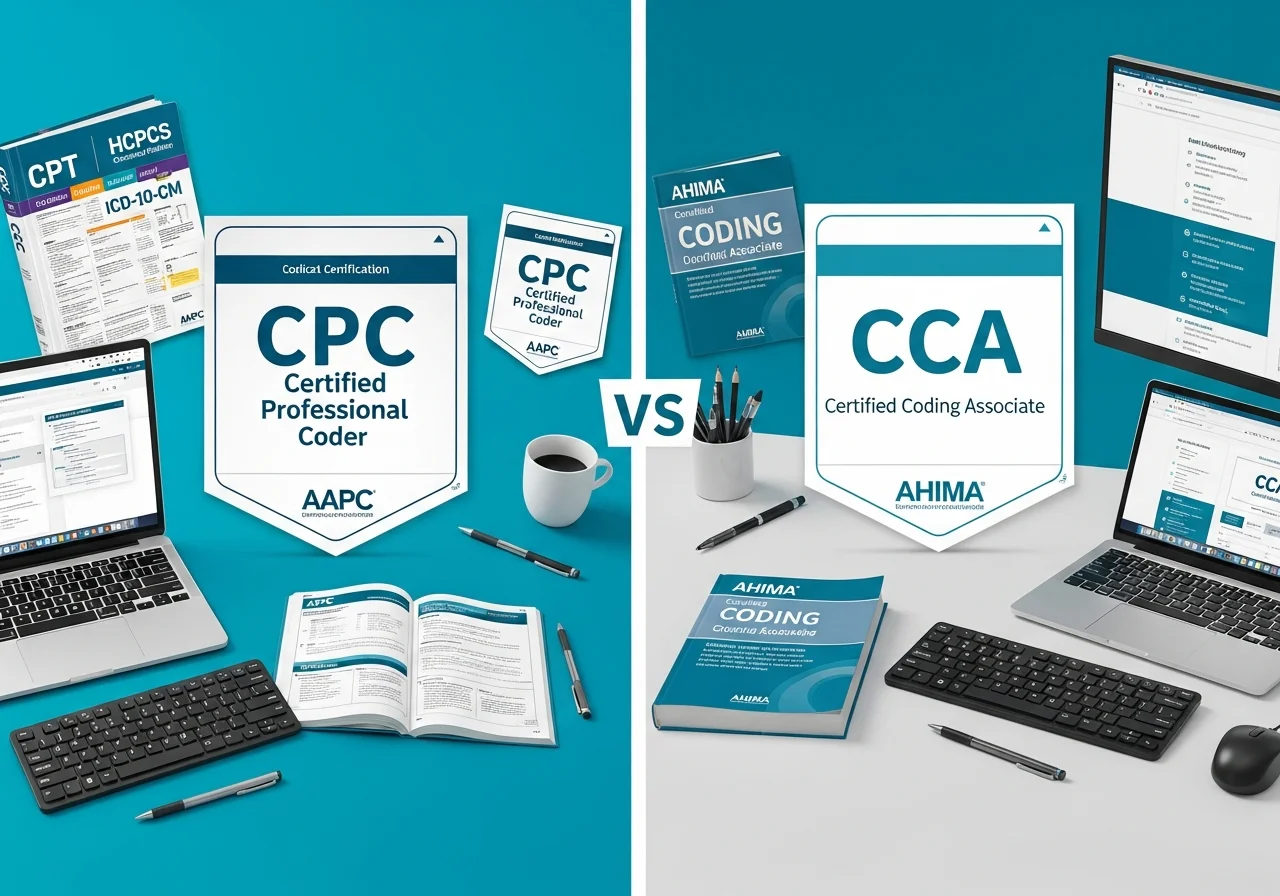
CPC vs CCA: Which Certification?
Comparing AAPC and AHIMA entry-level certifications: cost, difficulty, employer preference, and career impact.

Can AI Replace Medical Coders?
What automation means for medical coders: which tasks are changing and which skills remain essential.

Angela R.
Medical Billing & Coding Specialist | Consultant
Angela worked as a medical billing and coding specialist for multiple chiropractors and orthopedic surgeons. After years in the field, she started her own medical billing and coding consulting company, working with numerous clients throughout Southern California. She brings firsthand industry experience to every article on this site.