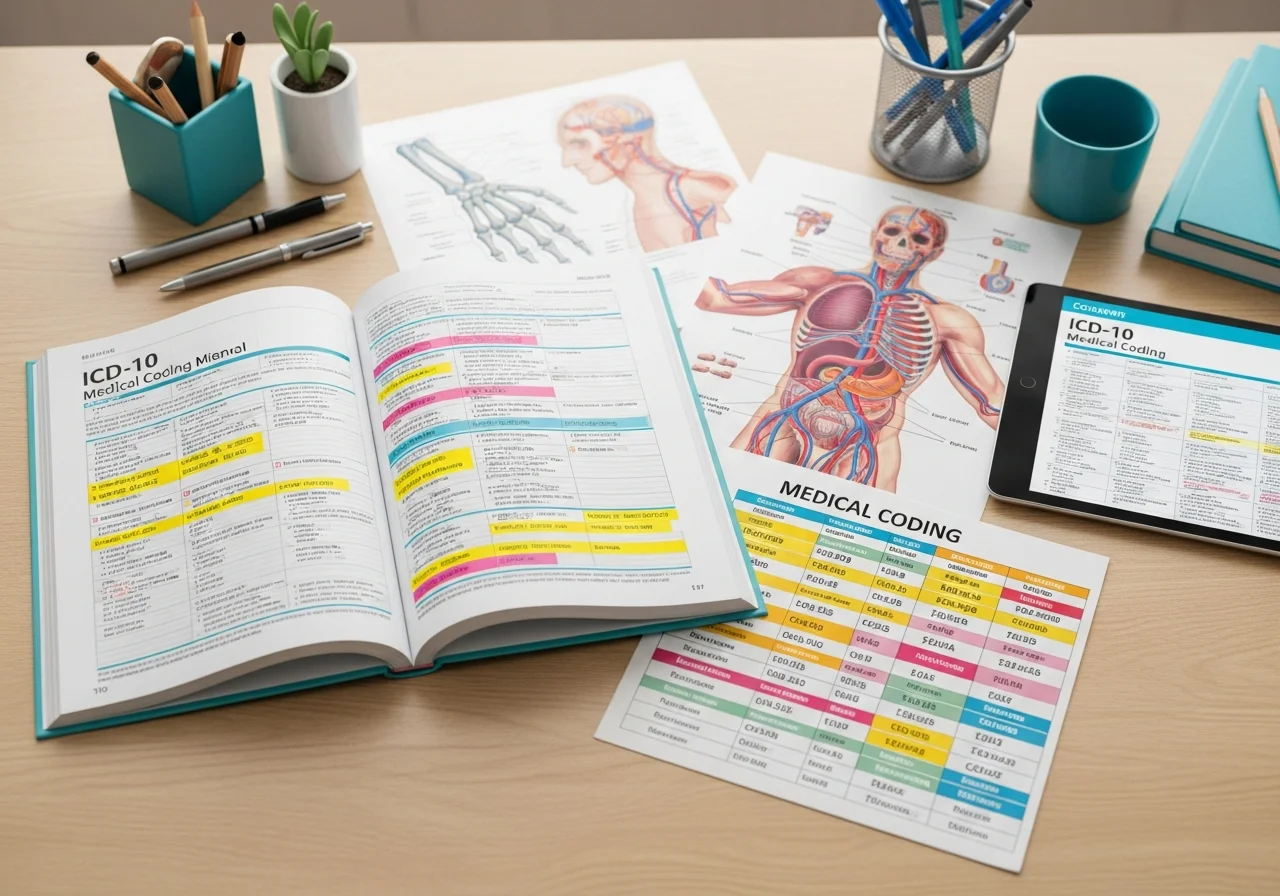
ICD-10 basics are foundational for every medical billing and coding career. ICD-10-CM (Clinical Modification) contains roughly 72,000 diagnosis codes organized across 21 chapters. Each code follows a structured format: 3-7 alphanumeric characters that identify the category, anatomical site, severity, laterality, and encounter type. Understanding ICD-10-CM structure, guidelines, and sequencing rules is essential for certification exams (CPC, CCA, CBCS) and daily coding work.
- 1.ICD-10-CM contains approximately 72,000 diagnosis codes. You don't memorize them. You learn the structure and guidelines so you can navigate the code set efficiently.
- 2.Every ICD-10-CM code starts with a letter (A-T, V-Z), followed by 2 digits, then up to 4 additional characters after a decimal point. The structure tells you the category, etiology, anatomical site, severity, and encounter type.
- 3.ICD-10-CM has 21 chapters organized by body system or condition type. Knowing the chapter layout helps you find codes faster during exams and production coding.
- 4.Coding guidelines published by the CDC and CMS are binding. They aren't suggestions. Your ICD-10-CM coding must follow the Official Guidelines for Coding and Reporting.
- 5.Understanding ICD-10 basics is critical for the CPC exam, which dedicates roughly 30% of its questions to ICD-10-CM content.
~72,000
Total Codes
ICD-10-CM
21
Chapters
By body system
3-7 chars
Code Length
Alphanumeric
Oct. 1
Annual Update
CDC/CMS
What Is ICD-10-CM?
ICD-10-CM stands for International Classification of Diseases, 10th Revision, Clinical Modification. It's the diagnosis coding system used in the United States for all healthcare settings. Every time a patient visits a provider, the diagnoses documented in that encounter are translated into ICD-10-CM codes for billing, tracking, and public health purposes.
The "CM" (Clinical Modification) is important. The World Health Organization maintains the base ICD-10 system internationally, but the U.S. version (ICD-10-CM) was adapted by the CDC's National Center for Health Statistics (NCHS) and CMS to add the clinical detail American healthcare billing requires. That's why the U.S. code set is significantly larger than the international version.
ICD-10-CM replaced ICD-9-CM on October 1, 2015, expanding from roughly 14,000 codes to approximately 72,000. The expansion wasn't arbitrary. It added laterality (left vs. right), specificity of anatomical site, episode of care (initial, subsequent, sequela), and clinical detail that ICD-9-CM couldn't capture.
For medical billing and coding professionals, ICD-10-CM is one of three core code sets you'll use daily, alongside CPT (procedures) and HCPCS Level II (supplies, drugs, durable medical equipment). Mastering ICD-10 basics is the starting point for every medical coding career path.
Source: CDC/CMS
ICD-10-CM Code Structure
Every ICD-10-CM code follows a specific alphanumeric structure. Understanding this structure lets you decode any code at a glance.
Characters 1-3 (Category): The first character is always a letter (A through T, or V through Z). Characters 2 and 3 are digits. Together, these three characters identify the code category. For example, J18 = Pneumonia, organism unspecified.
Character 4 (Subcategory): After a decimal point, the 4th character adds specificity. J18.1 = Lobar pneumonia, unspecified organism. Not all codes have characters beyond the 3rd, but when they do, you must code to the highest level of specificity the documentation supports.
Characters 5-7 (Detail): These provide additional clinical detail such as laterality (right vs. left), severity, anatomical specificity, or episode of care. For example, S52.501A = Unspecified fracture of the lower end of right radius, initial encounter. The 'A' at the end indicates this is the initial encounter.
7th character extensions are common in injury and musculoskeletal codes. The three most common: A (initial encounter), D (subsequent encounter), S (sequela). Placeholder 'x' is used when a code requires a 7th character but has fewer than 6 characters. For example, T36.0x1A = poisoning by penicillins, accidental, initial encounter.
The 21 Chapters of ICD-10-CM
ICD-10-CM organizes its roughly 72,000 codes into 21 chapters. Most chapters are organized by body system (respiratory, digestive, musculoskeletal). A few are organized by etiology (infectious diseases, neoplasms, external causes). Knowing the chapter layout helps you navigate the code set faster during production coding and certification exams.
The chapters most heavily tested on the CPC exam include: Chapter 5 (Mental, Behavioral), Chapter 9 (Circulatory), Chapter 10 (Respiratory), Chapter 13 (Musculoskeletal), Chapter 19 (Injury/Poisoning), and Chapter 21 (Z-codes for encounters without active disease). Pay special attention to these during your study preparation.
Key chapters to know: Chapter 1 (A00-B99) covers infectious and parasitic diseases. Chapter 2 (C00-D49) covers neoplasms with behavior codes that indicate malignant, benign, in-situ, or uncertain behavior. Chapter 4 (E00-E89) covers endocrine, nutritional, and metabolic diseases including diabetes coding, which is one of the most complex areas because of the combination code system. Chapter 19 (S00-T88) covers injury and poisoning with mandatory 7th character extensions.
Source: AAPC CPC Exam Content Outline
ICD-10-CM Coding Guidelines You Need to Know
The ICD-10-CM Official Guidelines for Coding and Reporting are published by the CDC and CMS. They're not optional. These guidelines are the authoritative rules for code selection, sequencing, and reporting. Here are the most important concepts:
Code to the highest level of specificity. If a code has 7 characters available and the documentation supports all 7, you must use the full code. Using a 3-character category code when a more specific code exists is incorrect and will likely result in a claim denial.
Sequencing rules. The first-listed diagnosis (principal diagnosis in inpatient settings) should be the condition chiefly responsible for the encounter. Additional diagnoses are sequenced based on clinical significance. Some code categories have specific sequencing rules, such as "code first" and "use additional code" notes built into the tabular list.
Signs and symptoms vs. confirmed diagnoses. If the provider documents a confirmed diagnosis, code the diagnosis, not the symptoms. Signs and symptoms are coded only when a definitive diagnosis hasn't been established. Exception: if a sign/symptom isn't routinely associated with the confirmed diagnosis, it can be coded as an additional diagnosis.
"Excludes1" vs. "Excludes2" notes. Excludes1 means the two conditions can't occur together, so you can't use both codes. Excludes2 means the conditions can occur together but aren't included in this code, so you may use both if documented. This distinction trips up many new coders.
Answers 'WHY' the patient was seen. Describes diagnoses, symptoms, and conditions. Maintained by CDC/CMS. Updated October 1. Contains ~72,000 codes. Alphanumeric (3-7 characters).
Answers 'WHAT' was done to the patient. Describes procedures, services, and evaluations. Maintained by the AMA. Updated January 1. Contains ~10,000 codes. Numeric (5 digits).
Covers items not in CPT: drugs, DME, supplies, ambulance services. Maintained by CMS. Alphanumeric (1 letter + 4 digits).
Practical ICD-10-CM Coding Examples
Understanding ICD-10-CM structure in the abstract isn't enough. Here are practical examples of how you'd apply it in real coding scenarios:
Example 1: Type 2 diabetes with diabetic nephropathy. Code E11.21 (Type 2 diabetes mellitus with diabetic chronic kidney disease). This is a combination code: one code captures both the diabetes and the complication. You don't code diabetes and nephropathy separately. You'd add a code from N18.- to specify the stage of chronic kidney disease if documented.
Example 2: Patient presents with chest pain, workup is negative. Code R07.9 (Chest pain, unspecified) or a more specific chest pain code based on documentation. Because no definitive diagnosis was established during the encounter, you code the symptom. If the provider documented "chest pain, rule out MI" and the MI was ruled out, you still code the chest pain, not the MI.
Example 3: Fracture of right ankle, initial visit. Code S82.891A (Other fracture of right lower leg, initial encounter). Note the laterality (right = 1 in the 6th position) and the 7th character 'A' for initial encounter. On follow-up visits, you'd change the 7th character to 'D' (subsequent encounter) or 'S' (sequela, if the patient develops a complication from the original injury).
Source: BLS OEWS, May 2024
Next Steps for Learning ICD-10-CM
ICD-10 basics are your foundation, but coding proficiency comes from practice. Work through case studies in your training materials, use AAPC's Practicode to code real medical records, and study the Official Guidelines chapter by chapter. If you're preparing for a certification exam, our CPC exam study guide includes a week-by-week plan that covers ICD-10-CM in depth.
For a broader overview of the career path, certification options, and salary expectations, visit our how to become a medical coder guide and certification comparison.
Source: AAPC 2025 Salary Survey
Frequently Asked Questions
Latest Articles

Medical Billing and Coding Industry Trends 2026
AI-assisted coding, value-based care, and remote work are reshaping the medical coding profession.
CPC vs CCA: Which Certification?
Comparing AAPC and AHIMA entry-level certifications: cost, difficulty, employer preference, and career impact.

Can AI Replace Medical Coders?
What automation means for medical coders: which tasks are changing and which skills remain essential.

Angela R.
Medical Billing & Coding Specialist | Consultant
Angela worked as a medical billing and coding specialist for multiple chiropractors and orthopedic surgeons. After years in the field, she started her own medical billing and coding consulting company, working with numerous clients throughout Southern California. She brings firsthand industry experience to every article on this site.