- 1.The CPC (Certified Professional Coder) is issued by AAPC and focuses on physician-office and outpatient coding. The CCA (Certified Coding Associate) is issued by AHIMA and serves as an entry-level credential for both inpatient and outpatient settings.
- 2.CPC exam: 100 multiple-choice questions, 4-hour time limit, open codebook, $425 for one attempt ($499 for two). Requires AAPC membership ($222/year, $157 for students).
- 3.CCA exam: 105 questions (90 scored, 15 pretest), 2-hour time limit, open codebook (ICD-10-CM/PCS, CPT), $199 for AHIMA members or $299 for non-members.
- 4.The CPC is more widely recognized in physician-office and outpatient job postings. The CCA carries more weight in hospital and health-system environments where AHIMA credentials are standard.
- 5.Certified coders earn an average of $62,689 per year — about $7,000 more than uncertified peers (AAPC 2025 Salary Survey).
CPC and CCA: What Each Credential Covers
The CPC (Certified Professional Coder) is AAPC's flagship coding credential and the most widely held medical coding certification in the United States. It validates proficiency in assigning CPT, ICD-10-CM, and HCPCS Level II codes for physician-office and outpatient services. The CPC is the credential most commonly listed as required or preferred in outpatient coding job postings.
The CCA (Certified Coding Associate) is AHIMA's entry-level coding credential. It covers both outpatient and inpatient coding fundamentals, including ICD-10-CM, ICD-10-PCS (procedure coding for inpatient settings), and CPT. AHIMA positions the CCA as a starting point for coders who plan to work in hospitals, health systems, or health information management departments.
The key distinction: AAPC credentials are rooted in the physician-practice and outpatient world, while AHIMA credentials historically align with hospital-based health information management. Both organizations are nationally recognized, and many experienced coders hold credentials from both.
Exam Format and Cost Comparison
CPC exam details. The CPC consists of 100 multiple-choice questions with a 4-hour time limit. It is an open-codebook exam — test-takers may bring their current-year ICD-10-CM, CPT Professional Edition, and HCPCS Level II manuals, which can be tabbed and annotated. A passing score is 70% (70 correct out of 100). The exam costs $425 for one attempt or $499 for two attempts. AAPC membership is required: $222 per year for professionals or $157 for students. The total minimum investment is $582–$647 before study materials.
CCA exam details. The CCA has 105 questions (90 scored, 15 unscored pretest items) and a 2-hour time limit. It is also open-codebook, allowing ICD-10-CM, ICD-10-PCS, and CPT manuals. The passing threshold is a scaled score of 300. The exam costs $199 for AHIMA members or $299 for non-members. AHIMA membership is not required to sit for the exam, though members receive the discounted rate. AHIMA individual membership is $199 per year.
Difficulty comparison. The CPC is generally considered the more challenging exam, primarily because of its length and time pressure. With 100 questions in 4 hours, test-takers have about 2.4 minutes per question — many of which involve multi-step coding scenarios requiring codebook lookups. The CCA, at 2 hours for 105 questions (roughly 1.1 minutes per scored question), moves faster but covers less procedural depth. The CPC's deeper focus on CPT surgical coding and E/M guidelines demands more preparation time for most candidates.
CPC vs CCA: Side-by-Side Comparison
| Feature | CPC (AAPC) | CCA (AHIMA) |
|---|---|---|
| Issuing Body | AAPC | AHIMA |
| Credential Level | Professional | Entry-level (Associate) |
| Focus Area | Outpatient / physician office | Inpatient and outpatient |
| Exam Questions | 100 multiple-choice | 105 (90 scored + 15 pretest) |
| Time Limit | 4 hours | 2 hours |
| Passing Score | 70% (70/100) | Scaled score of 300 |
| Open Book? | Yes (ICD-10-CM, CPT, HCPCS) | Yes (ICD-10-CM, ICD-10-PCS, CPT) |
| Exam Cost | $425 (1 attempt) / $499 (2 attempts) | $199 (AHIMA member) / $299 (non-member) |
| Membership Required? | Yes — AAPC ($222/yr, $157 student) | No (but members get discount) |
| Total Minimum Cost | $582–$647 | $199–$299 |
| Renewal Cycle | 2 years / 36 CEUs | 2 years / 20 CEUs |
| Apprentice Designation? | Yes (CPC-A until experience verified) | No |
| Best For | Physician-office and outpatient coders | Career starters; hospital-track coders |
Which Do Employers Prefer?
Employer preference depends on the work setting. In physician practices, outpatient clinics, ambulatory surgical centers, and billing companies, the CPC is the most frequently requested credential. Many job postings in these settings list "CPC required" or "CPC preferred" without mentioning AHIMA alternatives.
In hospitals and health systems, AHIMA credentials carry more recognition. Health information management (HIM) departments, which oversee medical records and coding operations in hospital settings, have historically aligned with AHIMA's credentialing framework. The CCA is often accepted for entry-level hospital coding roles, with the CCS (Certified Coding Specialist) — AHIMA's advanced credential — preferred for experienced inpatient coders.
For remote coding positions, both credentials are accepted, though the CPC appears more frequently in outpatient remote job listings. Companies like Optum and Datavant (formerly Ciox Health) typically list CPC, CCS, or CCA as qualifying credentials, giving holders of either certification access to these roles.
Many experienced professionals hold certifications from both AAPC and AHIMA, which maximizes flexibility across practice settings. AAPC's 2025 salary data shows that coders with two certifications average $71,130 per year, and those with three or more reach $81,227 — regardless of which organization issued the credentials.
Career Paths After Certification
After the CPC: The CPC positions you for outpatient coding roles in physician offices, multi-specialty groups, and billing companies. From there, common advancement paths include specialty coding (AAPC offers 20+ specialty credentials), coding auditor (CPMA), risk-adjustment coding (CRC), and coding team management. The CPC also qualifies you for most remote outpatient coding positions.
After the CCA: The CCA provides an entry point into hospital-based coding and health information management. AHIMA's next-level credential is the CCS (Certified Coding Specialist), which validates advanced inpatient and outpatient hospital coding ability. From there, coders can pursue the RHIT (Registered Health Information Technician) or RHIA (Registered Health Information Administrator) for management-track roles in HIM departments.
Neither certification locks you into one path. A CCA holder can later earn a CPC, and vice versa. The question is where you want to start and which exam format, cost, and study commitment best fits your current situation.
Which Should You Choose?
Choose the CPC if: You want to work in physician offices, outpatient clinics, or billing companies. You are comfortable with a longer, more detailed exam and the higher upfront cost. You want the most widely recognized outpatient coding credential, which appears in the majority of physician-office and remote coding job postings. Learn more in our full CPC guide.
Choose the CCA if: You are on a tighter budget and want a lower-cost entry point into coding ($199–$299 vs. $582+). You prefer a shorter exam (2 hours vs. 4 hours). You are interested in hospital-based coding or health information management, where AHIMA credentials are standard. You plan to eventually pursue the CCS or other AHIMA credentials. See our full CCA guide for exam details.
Consider both if: You have the time and budget to earn credentials from both organizations. Holding both a CPC and a CCA (or CCS) maximizes your options across outpatient and inpatient settings. This dual-credential approach is especially useful for coders targeting remote positions, where employers list multiple acceptable certifications.
If you are starting from scratch with no coding education, most training programs prepare students for either the CPC or the CCA as part of the curriculum. Check which certification your program aligns with before enrolling — switching exam tracks after completing coursework costs extra time and study effort. Our how to become a medical coder guide walks through the full training-to-certification pathway.
Frequently Asked Questions
Latest Articles

Medical Billing and Coding Industry Trends 2026
AI-assisted coding, value-based care, and remote work are reshaping the medical coding profession.
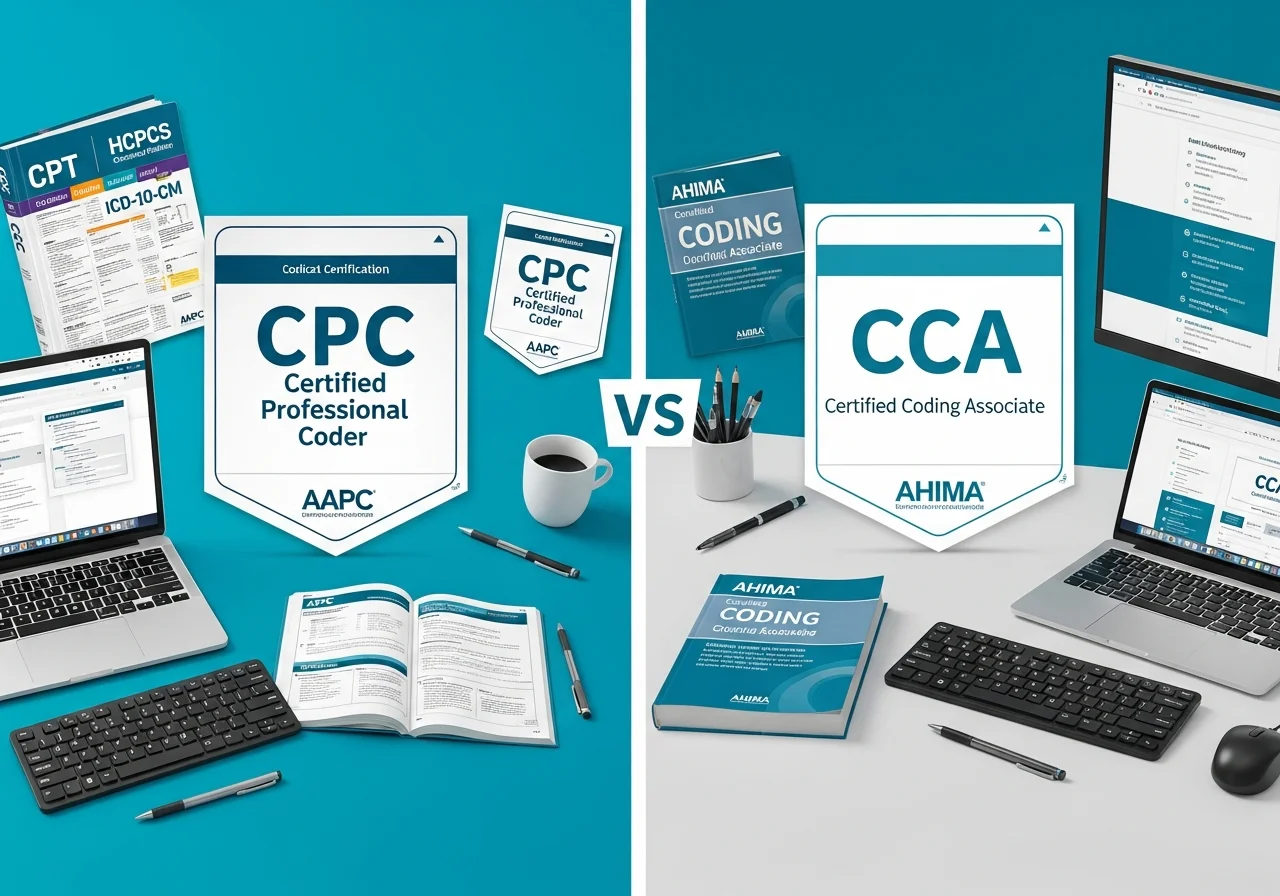
CPC vs CCA: Which Certification?
Comparing AAPC and AHIMA entry-level certifications: cost, difficulty, employer preference, and career impact.

Can AI Replace Medical Coders?
What automation means for medical coders: which tasks are changing and which skills remain essential.

Angela R.
Medical Billing & Coding Specialist | Consultant
Angela worked as a medical billing and coding specialist for multiple chiropractors and orthopedic surgeons. After years in the field, she started her own medical billing and coding consulting company, working with numerous clients throughout Southern California. She brings firsthand industry experience to every article on this site.