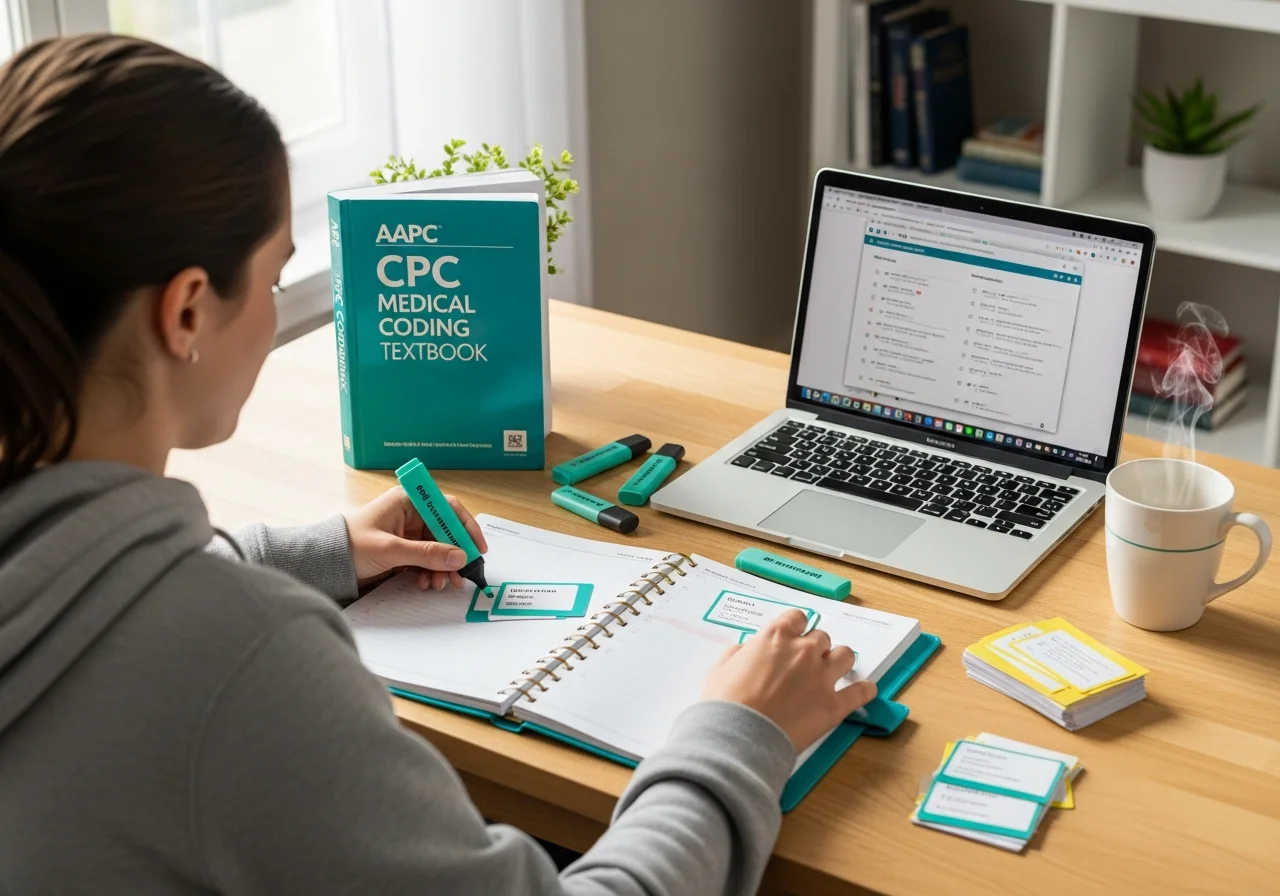
Studying for the CPC exam takes 12-16 weeks of focused preparation at 10-15 hours per week. The exam is 100 multiple-choice questions in 4 hours (about 2.4 minutes per question), and you need 70% to pass. It's open-book, so your ICD-10-CM, CPT, and HCPCS Level II manuals come with you. Tabbing and annotating your codebooks is the single most effective time-saving strategy. CPC-certified coders earn an average of $58,895 per year, and AAPC-certified coders overall average $66,979.
- 1.The CPC exam is 100 multiple-choice questions with a 4-hour time limit, giving you roughly 2.4 minutes per question.
- 2.A passing score is 70% (70 correct out of 100). The exam is open-book: you can bring your ICD-10-CM, CPT, and HCPCS Level II manuals.
- 3.The most heavily weighted sections are surgical CPT coding (~40%), ICD-10-CM guidelines (~30%), and Evaluation and Management (E/M).
- 4.Tabbing and annotating your codebooks before exam day is the most effective time-saving strategy during the test.
- 5.Most study plans recommend 12-16 weeks of focused preparation at 10-15 hours per week.
- 6.CPC-certified coders earn an average of $58,895 per year. AAPC-certified coders overall average $66,979 (AAPC 2025 Salary Survey).
100
Exam Questions
Multiple choice
4 hours
Time Limit
~2.4 min/question
70%
Passing Score
70 of 100 correct
$58,895
CPC Avg. Salary
AAPC, 2025
12-to-16-Week CPC Exam Study Plan
A structured timeline keeps you on track and prevents the common mistake of spending too long on one section while neglecting others. This plan assumes 10-15 hours of study per week. Adjust the pace based on your prior experience with medical terminology and coding.
Weeks 1-3: Foundations. Medical terminology, anatomy and physiology review, and the structure of ICD-10-CM, CPT, and HCPCS Level II code sets. Focus on understanding how each system is organized rather than memorizing codes. Learn the conventions, symbols, and formatting used in each manual.
Weeks 4-6: ICD-10-CM Deep Dive. Work through the ICD-10-CM Official Coding Guidelines chapter by chapter. Practice assigning diagnosis codes using case scenarios. Pay attention to combination codes, sequencing rules, and guidelines for coding signs/symptoms versus confirmed diagnoses. ICD-10-CM typically represents roughly 30% of exam content.
Weeks 7-10: CPT Coding. This is the largest exam section (approximately 40% of questions). Cover E/M codes, surgical coding across all CPT sections (integumentary, musculoskeletal, respiratory, cardiovascular, digestive, urinary, nervous system), anesthesia, radiology, pathology/lab, and medicine. Learn modifier usage thoroughly. Modifiers 25, 26, 50, 51, 52, 58, 59, 62, 66, and 80 appear frequently.
Weeks 11-12: HCPCS Level II, Compliance, and Review. Study HCPCS Level II codes (drugs, DME, supplies, services). Review compliance and regulatory guidelines including HIPAA, fraud and abuse, and NCCI edits. Revisit any weak areas identified during practice tests.
Weeks 13-16: Full-Length Practice Exams. Take at least 3-5 full-length, timed practice exams under realistic conditions: 100 questions in 4 hours. Review every wrong answer and the reasoning behind the correct one. Adjust your codebook tabs based on which sections slow you down.
Source: AAPC CPC Exam Content Outline
Recommended CPC Exam Study Materials
You don't need every resource on the market. A focused set of materials is more effective than trying to cover everything.
Required Codebooks. You need the current year's editions of the CPT Professional Edition, ICD-10-CM codebook, and HCPCS Level II codebook. These are the same books you'll bring to the exam. Buy them early and study from the actual manuals you'll use on test day. AAPC sells a bundled set, but you can also purchase individually from the AMA (CPT) and other publishers.
AAPC CPC Study Guide. The official AAPC study guide is aligned directly with the exam content outline. It covers each domain systematically and includes practice questions. This is the closest match to what you'll see on the actual exam.
Practice Exams. AAPC offers official practice exams for purchase. Third-party options from CCO (Certified Coder Online) and Mometrix are also well-regarded. Timed practice exams are the single most effective tool for building speed and confidence.
Free Supplements. Use ICD10Data.com for quick code lookups during study sessions. The CMS Medicare Learning Network offers free ICD-10-CM and billing training. YouTube channels like Contempo Coding provide free video walkthroughs. See our free resources guide for a full list.
Covers all CPT surgical subsections. Integumentary and musculoskeletal codes appear most frequently. Requires strong modifier knowledge.
Diagnosis coding, sequencing rules, combination codes, and the Official Guidelines. Chapter 19 (Injury) and Chapter 13 (Musculoskeletal) are heavily tested.
Office visits, hospital visits, and consultations. Know the 2021 E/M guideline changes for office/outpatient visits.
HIPAA, fraud/abuse, NCCI edits, HCPCS Level II codes, anesthesia, and medical terminology.
How to Tab Your Codebooks for the CPC Exam
Tab CPT sections
Mark the beginning of each major section: E/M, Anesthesia, each Surgery subsection (Integumentary, Musculoskeletal, Respiratory, Cardiovascular, Digestive, Urinary, Male/Female, Nervous, Eye/Ear), Radiology, Pathology, and Medicine.
Tab ICD-10-CM chapters
Mark each of the 21 chapters. Focus extra tabs on Chapter 19 (Injury/Poisoning), Chapter 13 (Musculoskeletal), and Chapter 9 (Circulatory) since these are heavily tested.
Tab HCPCS Level II sections
Mark the major alphabetical sections (A-codes through V-codes). HCPCS is a smaller portion of the exam, so fewer tabs are needed.
Color-code by manual
Use different tab colors for CPT, ICD-10-CM, and HCPCS. This lets you grab the right manual without looking. Practice navigating your tabbed manuals until it becomes muscle memory.
Annotate guidelines
Write notes directly in your codebooks near relevant code ranges: modifier rules, sequencing notes, Excludes1 vs. Excludes2 reminders, and commonly tested conventions. You're allowed to write in your manuals for the exam.
Source: AAPC (100 questions / 4 hours)
CPC Exam Strategies and Tips
Master the two-pass method. On your first pass through the exam, answer every question you can resolve in under 2 minutes. Mark harder questions and return to them on a second pass. This prevents spending 5-10 minutes on one difficult question early and running out of time at the end.
Prioritize high-weight sections. Surgical CPT coding and E/M coding together make up the largest portion of the exam. Invest disproportionate study time here. If you struggle with surgical coding, focus on integumentary and musculoskeletal first since they tend to appear most frequently.
Learn modifiers cold. Modifier questions appear throughout the exam, not just in a dedicated section. Know when to apply modifiers 25, 26, 50, 51, 52, 59, 76, 77, and the assistant-surgeon modifiers. Modifier misuse is one of the most common reasons for missed questions.
Don't panic over hard questions. The exam has a 70% passing threshold. You can miss 30 questions and still pass. If a question stumps you completely, make your best selection, mark it, and move on. Spending 8 minutes on one question costs you time for 3-4 other questions.
Test Day Preparation for the CPC Exam
Arrive early. Whether testing at a Pearson VUE center or an AAPC-proctored location, arrive at least 30 minutes before your scheduled start time. You'll need to check in, present valid identification, and set up your materials.
Bring the right materials. You're permitted to bring your ICD-10-CM, CPT, and HCPCS Level II codebooks. No electronic devices, notebooks, or loose papers allowed. Your manuals can be tabbed and annotated, but they can't contain removable notes or inserts.
Pace yourself. With 100 questions and 4 hours, you have 2.4 minutes per question on average. The two-pass method helps manage the variation between quick recall questions and complex surgical scenarios.
For a full overview of the CPC certification including eligibility requirements, career impact, and salary data, see our dedicated CPC guide. To compare the CPC with other entry-level certifications, visit our certification comparison.
Source: AAPC 2025 Salary Survey
Source: Keyword research, Feb 2026
Additional Study Resources
Looking for more help? Our free medical billing and coding resources page lists no-cost study tools, practice exams, and training materials. If you're deciding between certification bodies, our AAPC vs. AHIMA comparison covers the differences. And for a cost breakdown of the full training path, see our medical billing and coding cost guide.
Frequently Asked Questions
Latest Articles

Medical Billing and Coding Industry Trends 2026
AI-assisted coding, value-based care, and remote work are reshaping the medical coding profession.
CPC vs CCA: Which Certification?
Comparing AAPC and AHIMA entry-level certifications: cost, difficulty, employer preference, and career impact.

Can AI Replace Medical Coders?
What automation means for medical coders: which tasks are changing and which skills remain essential.

Angela R.
Medical Billing & Coding Specialist | Consultant
Angela worked as a medical billing and coding specialist for multiple chiropractors and orthopedic surgeons. After years in the field, she started her own medical billing and coding consulting company, working with numerous clients throughout Southern California. She brings firsthand industry experience to every article on this site.