
A career change to medical billing and coding is one of the fastest paths into healthcare. Most training programs take 4 to 12 months, cost $3,000 to $15,000, and don't require a college degree. The BLS projects 7% job growth through 2033 with 14,200 annual openings, and certified professionals earn an average of $66,979 per year. Your existing work experience in admin, finance, or healthcare roles transfers directly.
- 1.You don't need a college degree to enter medical billing and coding. Certificate programs take 4 to 12 months and prepare you for the CPC or CCA certification exam.
- 2.Program costs range from $3,000 to $15,000 depending on format. Online programs tend to be more affordable and offer flexibility for working adults.
- 3.Medical records specialists earn a median of $50,250/yr (BLS, May 2024). Certified professionals average $66,979/yr (AAPC 2025).
- 4.Existing skills from admin, accounting, insurance, customer service, or healthcare roles transfer directly to billing and coding work.
- 5.About 64.8% of medical coders work remotely at least part-time (AAPC 2024), making this a strong option for people seeking work-from-home careers.
4-12 mo
Training Timeline
$50,250
Median Annual Salary
14,200
Annual Job Openings
2.5%
CPC Unemployment Rate
Why Medical Billing and Coding for a Career Change
Medical billing and coding is one of the most popular career change targets for good reasons. The barrier to entry is low (no degree required), the training timeline is short (months, not years), and the job market is stable. The BLS reports 194,800 jobs nationally with 7% growth projected through 2033, which translates to roughly 14,200 openings every year from growth and replacement.
The remote work angle is a major draw for career changers. About 64.8% of coders work remotely at least part-time (AAPC 2024 Survey), so you can potentially work from home once you've built some experience. For people leaving jobs that require commuting, physical labor, or rigid schedules, this flexibility is a significant quality-of-life upgrade.
The pay is competitive for the training investment. The BLS median is $50,250/yr for all medical records specialists. Certified professionals earn considerably more, averaging $66,979 (AAPC 2025). Compared to many careers that require similar training time, that's a strong return. And unlike some fields where pay plateaus quickly, medical coding offers clear advancement paths through specialization and additional certifications.
Data entry accuracy, attention to detail, working with software systems, and managing organized workflows all translate directly. You're already comfortable with screen-based, detail-oriented work.
Understanding billing cycles, claims processing, financial terminology, and compliance requirements. Insurance adjusters, accounts receivable staff, and bookkeepers often pick up medical billing quickly.
Medical terminology, familiarity with clinical workflows, understanding patient records. Medical assistants, nurses, pharmacy techs, and front-desk staff already know the clinical side.
Communication skills, patience, problem-solving, and working under pressure. These soft skills matter for denial management, provider queries, and working with insurance representatives.
Research skills, attention to documentation detail, understanding regulations and compliance frameworks. The regulatory side of coding (HIPAA, fraud and abuse, payer rules) comes naturally.
Training and Certification Timeline for Career Changers
The fastest path from career changer to certified medical biller and coder follows this general timeline.
Months 1-4: Complete a training program. Certificate programs cover medical terminology, anatomy and physiology, ICD-10-CM coding, CPT coding, HCPCS Level II, billing procedures, and compliance. Online programs offer the most flexibility for people still working in their current job. Programs through community colleges, AAPC, or vocational schools are the most common options.
Months 5-8: Study for and pass your certification exam. Most career changers pursue the CPC (AAPC) because it's the most widely requested credential in job postings. The exam is 100 questions, 4 hours, open codebook, with a 70% passing threshold. If you're targeting hospital work, the CCA (AHIMA) is a solid alternative at a lower price point ($199-$299 vs. $425-$499).
Months 8-12: Job search and first position. Most certified coders find employment within 2 to 6 months of passing their exam. Career changers with relevant transferable experience (healthcare, admin, insurance) often find jobs faster because employers value professional maturity and existing office skills.
Source: Certificate program timelines
Cost and Financial Aid for Medical Billing and Coding Training
Training program costs vary significantly by format and institution. Here's what you can expect.
Certificate programs: $3,000 to $15,000. Online-only programs from AAPC and vocational schools tend to be on the lower end. Community college programs with in-person components are mid-range. Private vocational schools charge more.
Certification exam: CPC costs $425 (one attempt) or $499 (two attempts). CCA costs $199 for AHIMA members, $299 for non-members. Budget for codebooks as well, typically $150 to $250 for the set of three (ICD-10-CM, CPT, HCPCS).
Financial aid options: WIOA (Workforce Innovation and Opportunity Act) grants cover training costs for eligible career changers through your state's workforce development office. FAFSA financial aid applies to community college programs. Some employers offer tuition reimbursement if you're transitioning within healthcare. Payment plans are standard at most training programs. See our financial aid guide and cost breakdown for details.
Getting Your First Medical Billing and Coding Job After the Switch
Career changers actually have some advantages over traditional students. Employers value professional maturity, existing office skills, and the discipline that comes from managing a career transition while training.
Highlight your transferable experience. If you worked in insurance, mention claims processing. If you were in healthcare admin, emphasize your EHR familiarity and medical terminology knowledge. If you managed accounts receivable, that's directly relevant to the billing side. Frame your previous career as an asset, not a gap.
Target entry-friendly employers. Smaller physician offices, third-party billing companies, and single-specialty practices are more likely to hire career changers with certification but limited coding experience. Large health systems tend to have stricter experience requirements.
Use AAPC's Practicode program. If you need coding experience before your first job, Practicode lets you code 600+ real medical records and earns one year of experience credit toward removing the CPC-A apprentice designation. It also generates a recommendation letter for your applications.
For a detailed job search strategy, see our first coding job guide and entry-level careers page.
Source: AAPC 2025 Salary Survey
Common Concerns Career Changers Have
"Am I too old to switch?" No. Medical billing and coding has no age restrictions, and the work doesn't require physical demands that would limit older workers. Many successful career changers enter the field in their 30s, 40s, and 50s. Your life experience and professional maturity are advantages, not liabilities.
"I don't have a science background." You don't need one. Training programs cover the medical terminology and anatomy you'll need. You won't be diagnosing patients or interpreting clinical results. You'll be translating documentation into codes, which is a skill you learn during training.
"Will I earn enough?" The BLS median for medical records specialists is $50,250/yr. Certified coders average $66,979 (AAPC 2025). Coders with 3+ certifications average $81,227. If you're coming from a lower-paying field, this represents a meaningful increase. If you're coming from a higher-paying field, the trade-off is usually flexibility (remote work, predictable hours, low-stress environment) rather than raw salary.
"Can I study while working?" Yes. Most online certificate programs are self-paced or have evening/weekend schedules designed for working adults. You can realistically complete training in 4 to 6 months while working full-time if you dedicate 10 to 15 hours per week to studying.
Source: AAPC 2024 Salary Survey
What Career Changers Should Know About the Transition
The biggest adjustment for most career changers isn't the technical content. It's the pace of learning a new professional vocabulary. Medical terminology, anatomy references, and code set conventions feel overwhelming during the first few weeks. This is normal and expected. By month 2 or 3 of your program, the terminology starts becoming second nature.
Your first coding job probably won't be perfect. Entry-level salaries ($35,000 to $45,000) are below the $50,250 median because that median includes experienced coders. But advancement in this field is concrete and measurable. Each additional year of experience, specialty skill, and certification you add moves your salary upward. Many career changers reach the $60,000+ range within 3 to 5 years.
The unemployment rate for CPC-certified coders is just 2.5% (AAPC 2025), which is well below the national average. Once you're certified and working, job security in this field is strong. Healthcare doesn't stop needing billers and coders during economic downturns, and the aging U.S. population continues to drive demand for medical services and the coding that supports them.
Your Career Change Roadmap
Research training programs
Compare online programs and local community college options. Look for AAPC- or AHIMA-aligned curricula.
Apply for financial aid
Check WIOA eligibility through your state workforce office. Apply for FAFSA if using community college. Ask about payment plans.
Complete your training program
4 to 12 months depending on format. Focus on ICD-10-CM, CPT, and billing procedures.
Pass your certification exam
CPC ($425-$499) or CCA ($199-$299). Study 12 to 16 weeks with 10 to 15 hours per week.
Build experience and start your new career
Target entry-level positions at physician offices or billing companies. Use Practicode if you need coding hours.
Frequently Asked Questions
Latest Articles

Medical Billing and Coding Industry Trends 2026
AI-assisted coding, value-based care, and remote work are reshaping the medical coding profession.
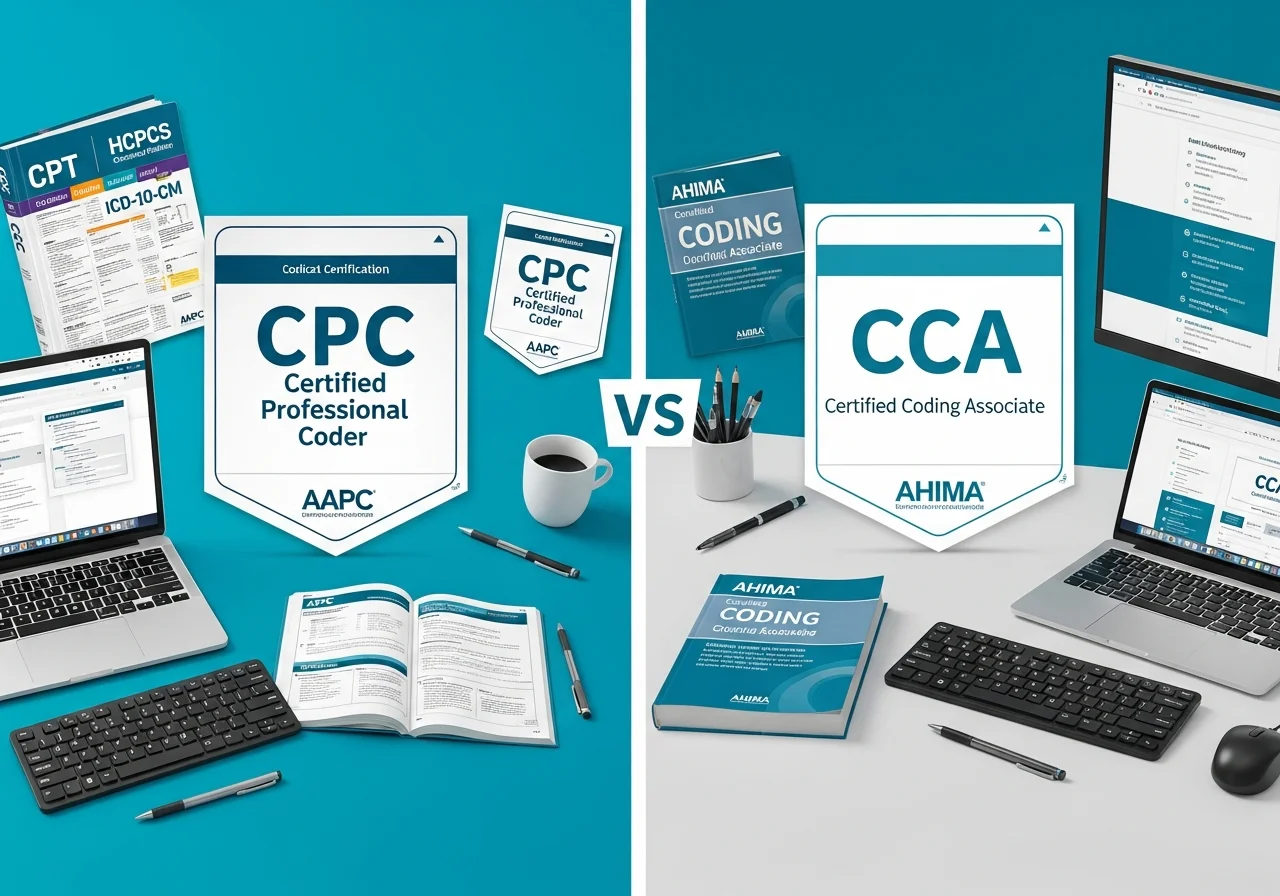
CPC vs CCA: Which Certification?
Comparing AAPC and AHIMA entry-level certifications: cost, difficulty, employer preference, and career impact.

Can AI Replace Medical Coders?
What automation means for medical coders: which tasks are changing and which skills remain essential.

Angela R.
Medical Billing & Coding Specialist | Consultant
Angela worked as a medical billing and coding specialist for multiple chiropractors and orthopedic surgeons. After years in the field, she started her own medical billing and coding consulting company, working with numerous clients throughout Southern California. She brings firsthand industry experience to every article on this site.