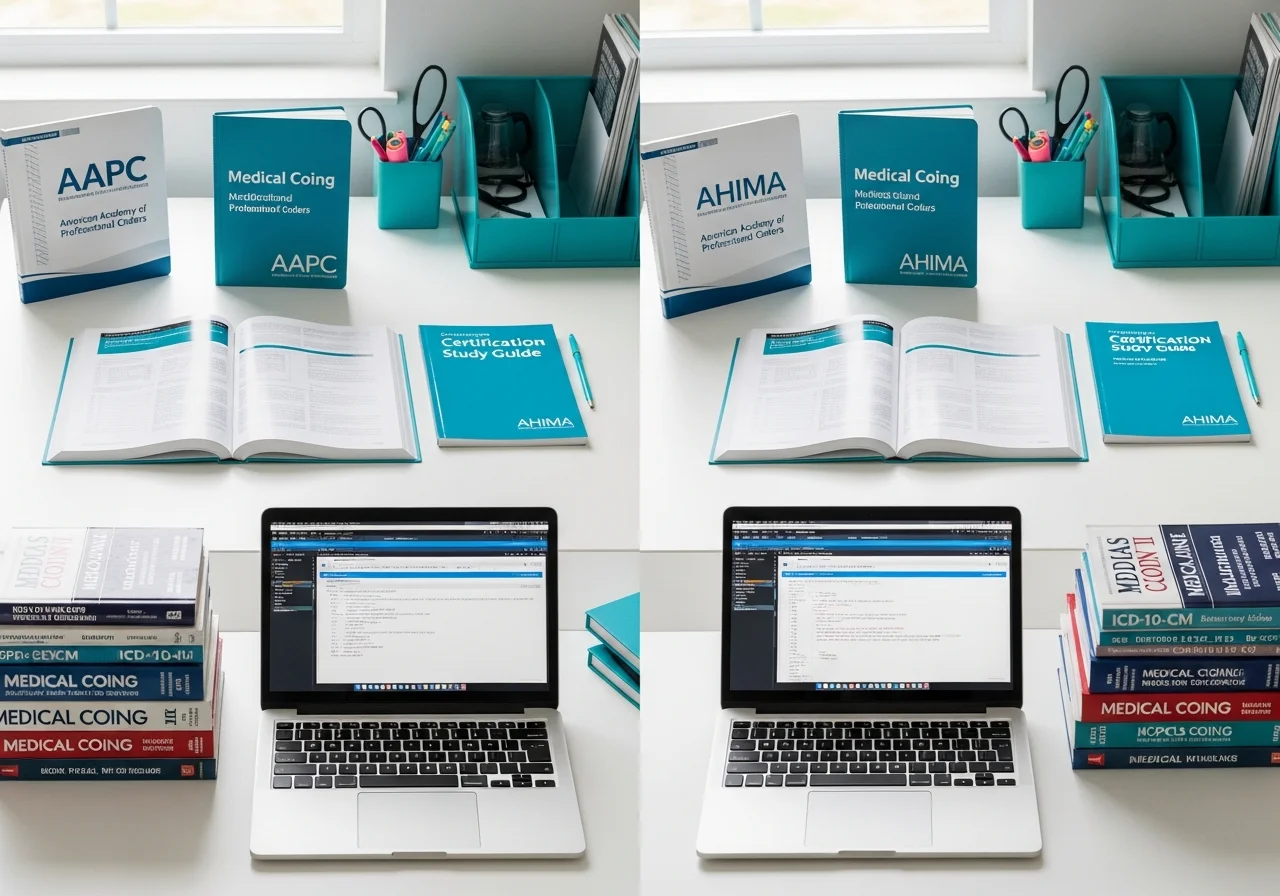
AAPC vs AHIMA is one of the first decisions you'll face in medical billing and coding. AAPC (founded 1988, 220,000+ members) focuses on outpatient and physician-office coding, with the CPC as its flagship credential. AHIMA (founded 1928, ~103,000 members) has deeper roots in hospital-based health information management. Neither is inherently better. The right choice depends on where you want to work.
- 1.AAPC (founded 1988) has 220,000+ members and focuses on outpatient/physician-office coding. Its flagship credential is the CPC ($425-$499).
- 2.AHIMA (founded 1928) is rooted in health information management (HIM) with strengths in inpatient and hospital coding. Entry credential: CCA ($199-$299). Advanced: CCS ($399-$499).
- 3.Employer preference splits by setting: physician offices lean AAPC (CPC), hospitals and health systems lean AHIMA (CCS).
- 4.AAPC requires 36 CEUs every 2 years. AHIMA requirements vary by credential.
- 5.Many experienced coders hold credentials from both organizations to maximize job flexibility. Coders with 3+ certifications earn an average of $81,227/yr (AAPC 2025).
220,000+
AAPC Members Worldwide
~103,000
AHIMA Members
$222/yr
AAPC Annual Membership
~$129/yr
AHIMA Annual Membership
AAPC vs AHIMA: Organizational Background
The American Academy of Professional Coders (AAPC) was established in 1988 to provide education and certification for professionals working in medical coding, billing, auditing, compliance, and revenue cycle management. AAPC reports 220,000+ members worldwide. The organization maintains a network of 500+ local chapters where members earn continuing education credits and network with peers.
The American Health Information Management Association (AHIMA) was founded in 1928, making it nearly 60 years older than AAPC. AHIMA's scope extends beyond coding into health information management (HIM), data integrity, privacy, and health information technology. AHIMA has approximately 103,000 members and manages state-level component associations in all 50 states.
The practical difference: AAPC grew up around physician-office and outpatient coding, while AHIMA has deeper roots in hospital-based HIM departments. Both organizations are nationally recognized, and neither credential is inherently "better" than the other. The right choice depends on the healthcare setting where you plan to work.
Source: AAPC 2025 Salary Survey
Certifications Offered by AAPC and AHIMA
AAPC credentials focus on coding, billing, auditing, and compliance:
CPC (Certified Professional Coder) is AAPC's flagship credential, designed for outpatient and physician-office coders. It's the most widely held medical coding certification in the U.S. Exam: 100 multiple-choice questions, 4 hours, open codebook, 70% passing score. Cost: $425 for one attempt, $499 for two attempts.
Other AAPC credentials: COC (outpatient hospital coding), CIC (inpatient hospital coding), CPB (billing specialist), CPMA (coding auditor), and 15+ specialty credentials including CEMC, CIRCC, and CRC (risk adjustment/HCC coding).
AHIMA credentials span coding and broader HIM roles:
CCA (Certified Coding Associate) is AHIMA's entry-level coding credential, covering both outpatient and inpatient coding fundamentals. Cost: $199 for AHIMA members, $299 for non-members. CCS (Certified Coding Specialist) is AHIMA's advanced credential, heavily weighted toward inpatient hospital coding. Cost: $399 for members, $499 for non-members.
Other AHIMA credentials: CCS-P (physician-based coding), CDIP (documentation improvement), RHIT (health info technician, requires associate degree), RHIA (health info administrator, requires bachelor's degree).
Certified Professional Coder. The most widely held outpatient coding credential. 100 questions, 4 hours, open book. $425-$499. Median salary: $58,895.
Certified Coding Associate. Entry-level credential covering outpatient and inpatient. 100 questions, 2 hours. $199-$299. Good for budget-conscious beginners.
Certified Coding Specialist. Advanced credential for hospital/inpatient coding. $399-$499. The go-to credential for hospital HIM departments.
Certified Professional Biller. For billing specialists focused on claims, denials, and revenue cycle. Often paired with CPC for dual coding/billing roles.
Which Certification Body Should You Choose?
The choice between AAPC and AHIMA depends on where you want to work and what kind of coding you want to do.
Choose AAPC (CPC) if: You plan to work in a physician office, outpatient clinic, ambulatory surgery center, or billing company. The CPC is the most commonly requested credential in job postings for outpatient coding roles. AAPC also has the largest local chapter network, which is useful for networking and earning CEUs.
Choose AHIMA (CCA or CCS) if: You want to work in a hospital HIM department, inpatient facility, or health system. The CCS is the credential most recognized by hospital employers, especially for inpatient DRG-based coding. If you're earlier in your career, the CCA is a lower-cost entry point at $199-$299 before moving up to the CCS.
If budget is a primary concern, AHIMA's CCA ($199-$299) costs less than AAPC's CPC ($425-$499). AHIMA's annual membership ($129) is also lower than AAPC's ($222). The total first-year cost difference is about $200 to $300.
Source: AAPC 2025 Salary Survey
Can You Hold Certifications From Both AAPC and AHIMA?
Yes, and many experienced coders do exactly this. There's no restriction on holding credentials from both organizations. A CPC plus a CCS covers you for both outpatient and inpatient settings, which maximizes your job flexibility and earning potential.
The trade-off is cost and maintenance. You'll need to maintain separate memberships (roughly $350/yr combined) and meet each organization's continuing education requirements independently. For most coders, the salary premium justifies the investment, especially for those who want the option to move between practice settings.
If you're just starting out, pick the credential that matches your target work setting, get certified, gain experience, and add the other organization's credential later if it makes sense for your career path. For a deeper look at salary outcomes by certification, see our salary guide.
Source: BLS OEWS, May 2024
Membership Benefits and Continuing Education
AAPC membership ($222/yr) includes access to 500+ local chapters, the Healthcare Business Monthly magazine (with CEU quizzes), online coding forums, a job board, and member discounts on training materials and conference registration. Student memberships are available at $157/yr.
AHIMA membership (~$129/yr) includes access to the Body of Knowledge online library, the Journal of AHIMA, state component association membership, career resources, and continuing education opportunities. AHIMA's scope extends beyond coding into broader HIM topics, so membership resources cover data analytics, privacy, and health IT.
Both organizations require continuing education to maintain active credentials. AAPC's requirement is 36 CEUs every 2 years for CPC holders, with at least 24 in your primary credential area. AHIMA requirements vary by credential. Free CEU sources are available through both organizations' chapter events, online webinars, and publications.
How to Decide Between AAPC and AHIMA
Identify your target work setting
Physician offices and outpatient clinics lean AAPC. Hospitals and health systems lean AHIMA. If you're unsure, start with AAPC (CPC) because it has broader job market coverage.
Compare costs
AHIMA's CCA ($199-$299 + $129/yr) is cheaper to start than AAPC's CPC ($425-$499 + $222/yr). Factor in total first-year costs when budgeting.
Check local job listings
Search Indeed and AAPC's job board for medical coding positions in your area. Note which credentials appear most often in the job postings you'd want.
Start with one, plan for both
Pick the credential matching your immediate career goal. You can always add the other organization's credential later as your career develops.
Source: AAPC 2025 Salary Survey
Frequently Asked Questions
Latest Articles

Medical Billing and Coding Industry Trends 2026
AI-assisted coding, value-based care, and remote work are reshaping the medical coding profession.
CPC vs CCA: Which Certification?
Comparing AAPC and AHIMA entry-level certifications: cost, difficulty, employer preference, and career impact.

Can AI Replace Medical Coders?
What automation means for medical coders: which tasks are changing and which skills remain essential.

Angela R.
Medical Billing & Coding Specialist | Consultant
Angela worked as a medical billing and coding specialist for multiple chiropractors and orthopedic surgeons. After years in the field, she started her own medical billing and coding consulting company, working with numerous clients throughout Southern California. She brings firsthand industry experience to every article on this site.