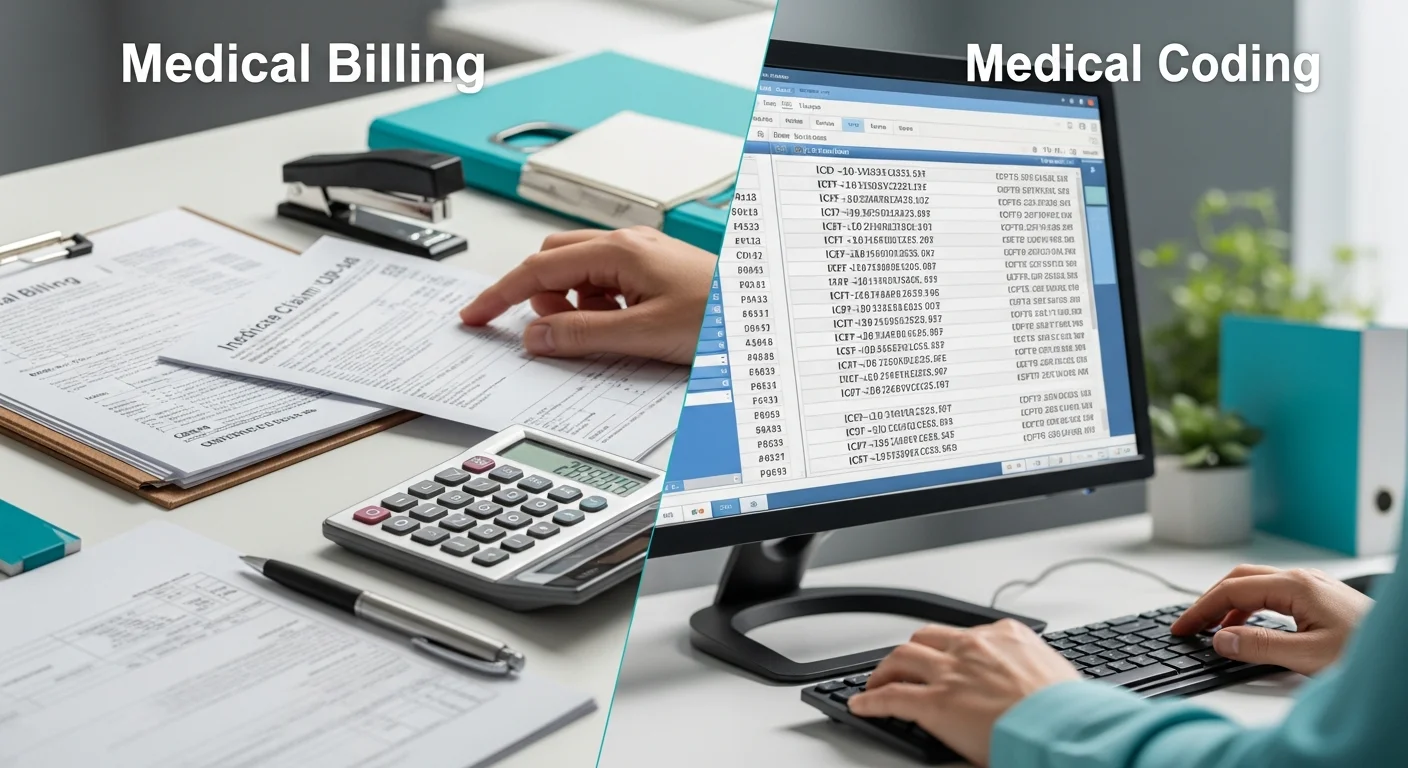
Medical billing vs coding comes down to what side of the revenue cycle you work on. Coders translate clinical documentation into standardized codes (ICD-10-CM, CPT, HCPCS). Billers submit those codes as insurance claims and manage the payment process. Both roles fall under BLS SOC 29-2072 with a median salary of $50,250 per year. Most training programs cover both, and many entry-level jobs combine the functions into one position.
- 1.Medical billing vs coding is a difference in focus: coders assign diagnosis and procedure codes from clinical records, while billers submit claims to insurance and manage payments.
- 2.The BLS groups both roles under Medical Records Specialists (SOC 29-2072) at a median salary of $50,250/year. AAPC data shows CPC-certified coders average $58,895 and CPB-certified billers average $56,981.
- 3.The CPC (AAPC) is the top coding credential. The CPB (AAPC) is the main billing credential. The CBCS (NHA) covers both and has the lowest exam fee at about $117.
- 4.Smaller practices often combine both functions into one position. Hospitals and billing companies typically separate them into distinct roles.
- 5.Most training programs teach both medical billing and coding together, so you don't have to choose before enrolling.
Medical Billing vs Coding: Overview
If you're researching the difference between medical billing and coding, here's the short version: coding happens first, billing happens second. A medical coder reviews clinical documentation from a patient visit and assigns standardized diagnosis and procedure codes. A medical biller takes those codes, builds an insurance claim, submits it, and follows up until the provider gets paid.
Job postings often list "medical billing and coding" as one role, and in many smaller practices it is. One person handles the full revenue cycle from code assignment through payment posting. Larger hospitals and third-party billing companies split these into separate positions with different daily responsibilities and skill sets.
Translating clinical documentation (physician notes, operative reports, lab results) into standardized alphanumeric codes using ICD-10-CM, CPT, and HCPCS Level II code sets.
Key Points
- ICD-10-CM/CPT/HCPCS knowledge
- Medical terminology
- Anatomy comprehension
- Analytical reading
Common Jobs
- • Outpatient coder
- • Inpatient hospital coder
- • Risk adjustment coder
- • Coding auditor
Creating insurance claims from coded encounters, submitting them to payers, tracking adjudication, managing denials and appeals, and posting payments. Also called revenue cycle management (RCM).
Key Points
- Claims management
- Insurance verification
- A/R follow-up
- Patient communication
Common Jobs
- • Medical biller
- • Claims specialist
- • A/R specialist
- • RCM manager
What Medical Coders Do
Medical coders read physician notes, operative reports, lab results, and other clinical records from patient encounters. They translate this information into standardized codes using three main systems:
- ICD-10-CM (International Classification of Diseases) -- over 72,000 diagnosis codes covering every documented condition
- CPT (Current Procedural Terminology) -- procedure and service codes maintained by the American Medical Association
- HCPCS Level II -- codes for supplies, equipment, and services not covered by CPT
The codes a coder assigns determine how much the provider gets reimbursed. Wrong codes lead to claim denials, underpayments, or compliance violations. Coders need a solid understanding of anatomy, medical terminology, and the clinical context behind what they're reading. Most coding work is independent and computer-based, which is why remote positions are common -- AAPC's 2025 survey reports that 64.8% of coders work from home.
Source: AAPC 2025 Salary Survey
What Medical Billers Do
Medical billers manage the financial side of the revenue cycle. After a coder assigns codes to a patient encounter, the biller creates a claim -- a standardized form (CMS-1500 for physician services, UB-04 for hospitals) -- and submits it to the patient's insurance company.
The job doesn't end with submission. Billers track claims through adjudication, follow up on unpaid or denied claims, handle appeals, post payments, and manage patient billing for remaining balances. This process is called accounts receivable (A/R) management or revenue cycle management (RCM).
Billers need to understand insurance contracts, payer-specific rules, coordination of benefits, and patient financial responsibility (copays, deductibles, coinsurance). They also verify insurance eligibility before services happen. Compared to coding, billing involves more people interaction -- with insurance reps, patients, and clinical staff.
Medical Coding
Record-focused, analytical, highly remote
Medical Billing
Claims-focused, communicative, business-oriented
Skills Required for Each Role
Shared skills: Medical terminology, anatomy and physiology basics, HIPAA compliance, attention to detail, EHR proficiency, and the ability to work independently. Both roles require you to be comfortable working at a computer for extended periods.
Coding-specific: Analytical thinking for interpreting clinical documentation. Deep knowledge of ICD-10-CM, CPT, and HCPCS code sets. Ability to navigate code books quickly (the open-book CPC exam tests this directly). Understanding of coding guidelines across different medical specialties.
Billing-specific: Communication skills for working with insurance reps and patients. Knowledge of claim submission processes and payer rules. A/R management. Familiarity with clearinghouse systems for electronic claims. Problem-solving for denied or rejected claims.
Source: BLS, May 2024 (SOC 29-2072)
Certifications for Billers and Coders
You don't need a certification to get hired, but most employers strongly prefer or require one. Here are the main credentials for each path.
Recommended Specializations
CPC (Certified Professional Coder)
AAPCThe most widely recognized coding credential. Covers ICD-10-CM, CPT, HCPCS Level II, coding guidelines, and compliance. Open-book, 150-question exam with a 5 hour 40 minute time limit.
CCA (Certified Coding Associate)
AHIMAEntry-level coding credential from AHIMA. Good starting point for those entering health information management. Lower exam fee than the CPC.
CPB (Certified Professional Biller)
AAPCThe primary billing-specific certification. Covers claims management, A/R, payer relations, compliance, and reimbursement methodologies.
CBCS (Certified Billing and Coding Specialist)
NHACovers both billing and coding fundamentals. Lowest exam fee of the major credentials. Solid option if you're not sure which path to specialize in.
CCS (Certified Coding Specialist)
AHIMAAdvanced coding credential focused on hospital inpatient coding. Designed for coders with experience who want to specialize in facility coding.
Salary Comparison: Billing vs Coding
The Bureau of Labor Statistics groups both medical billers and coders under Medical Records Specialists (SOC 29-2072), reporting a median salary of $50,250 per year as of May 2024. That makes it hard to isolate salary differences from federal data alone. For role-specific numbers, AAPC's 2025 Salary Survey is the best source.
AAPC reports that CPC-certified coders earn a median of $58,895 per year, while CPB-certified billers earn a median of $56,981. Professionals holding three or more certifications average $84,414 -- regardless of whether they started in billing or coding. The highest earners tend to be specialized coders in hospital inpatient coding, risk adjustment (HCC), or coding auditing, where salaries range from $70,000 to $85,000+.
For billing professionals, the strongest earning potential is in revenue cycle management. RCM managers who oversee billing departments can earn $65,000 to $90,000+ depending on the organization's size. See our salary guide for state-level data.
Source: AAPC 2025 Salary Survey
Which Should You Choose?
- Prefer working independently with medical records
- Enjoy analytical work and problem-solving
- Want the strongest remote work options (64.8% of coders are remote)
- Are comfortable navigating detailed code books and classification systems
- Want higher starting pay potential in specialized areas
- Prefer interacting with people (insurance reps, patients, clinical staff)
- Are interested in the financial and business side of healthcare
- Enjoy tracking down and resolving payment issues
- Want to work toward revenue cycle management leadership
- Like having variety in your daily tasks
- Want the widest range of job options right away
- Plan to work in a small practice where one person handles the full cycle
- Want to understand the complete picture before specializing
- Aren't sure yet and want to try both before committing
You Don't Have to Choose Before You Start
Most medical billing and coding programs cover both disciplines in a single curriculum. You'll learn coding systems (ICD-10-CM, CPT, HCPCS) alongside billing processes (claims, A/R, insurance verification). After completing a combined program, you choose which certification to pursue first based on what you enjoyed more.
Many professionals start in combined billing and coding roles, then specialize after a year or two of work experience. The training overlap is significant enough that switching between billing and coding later in your career is straightforward -- it usually means adding a new certification rather than starting over. Certificate programs cost $1,000 to $5,000 and take 4 to 15 months.
Frequently Asked Questions
Related Guides
Latest Articles

Medical Billing and Coding Industry Trends 2026
AI-assisted coding, value-based care, and remote work are reshaping the medical coding profession.
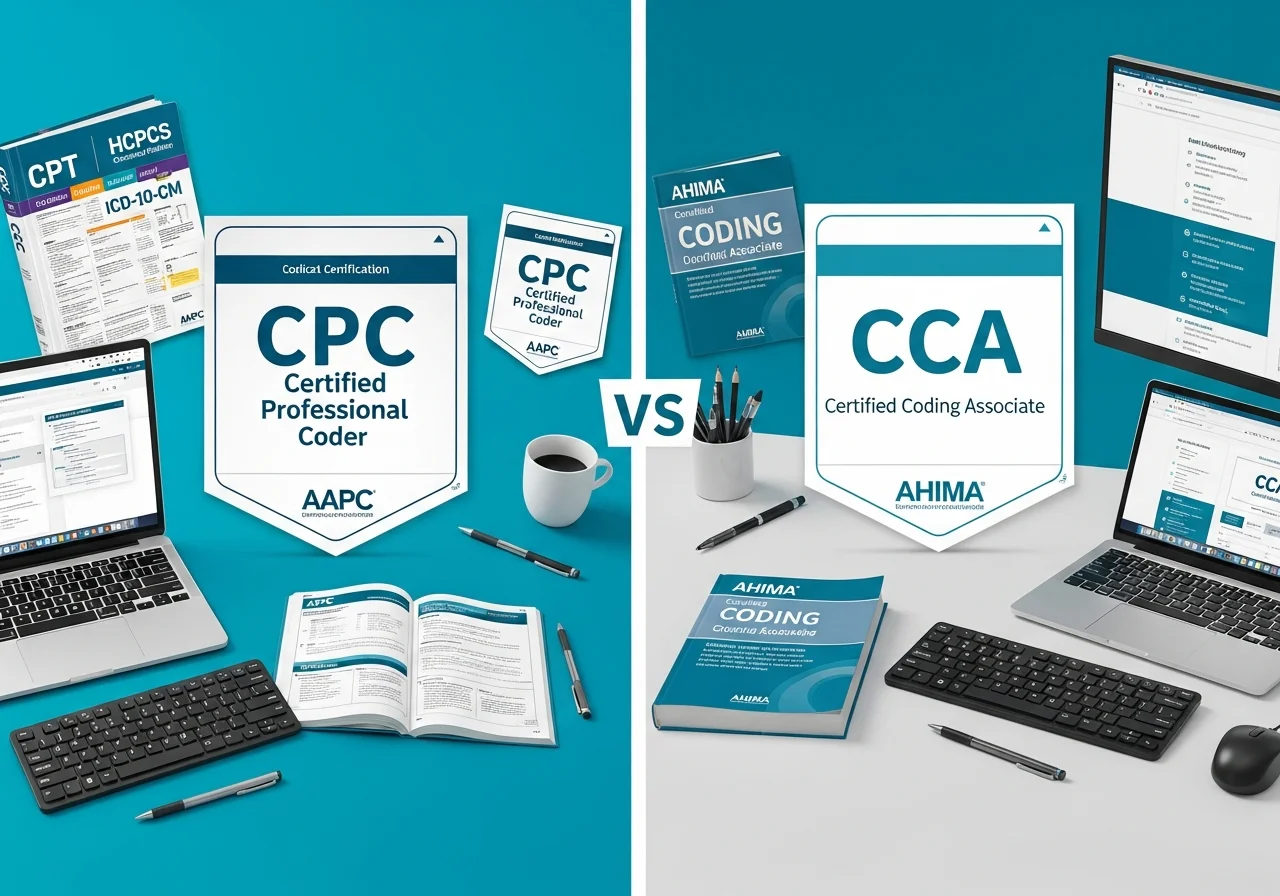
CPC vs CCA: Which Certification?
Comparing AAPC and AHIMA entry-level certifications: cost, difficulty, employer preference, and career impact.

Can AI Replace Medical Coders?
What automation means for medical coders: which tasks are changing and which skills remain essential.

Angela R.
Medical Billing & Coding Specialist | Consultant
Angela worked as a medical billing and coding specialist for multiple chiropractors and orthopedic surgeons. After years in the field, she started her own medical billing and coding consulting company, working with numerous clients throughout Southern California. She brings firsthand industry experience to every article on this site.